Introduction: Why Electrolyte Materials Matter in Lithium-ion Batteries
In lithium-ion batteries, electrolyte materials play a critical role in determining energy density, cycle life, safety, and overall electrochemical performance. While cathode and anode materials often receive the most attention, the electrolyte system directly controls lithium-ion transport, interfacial stability, and cell reliability.
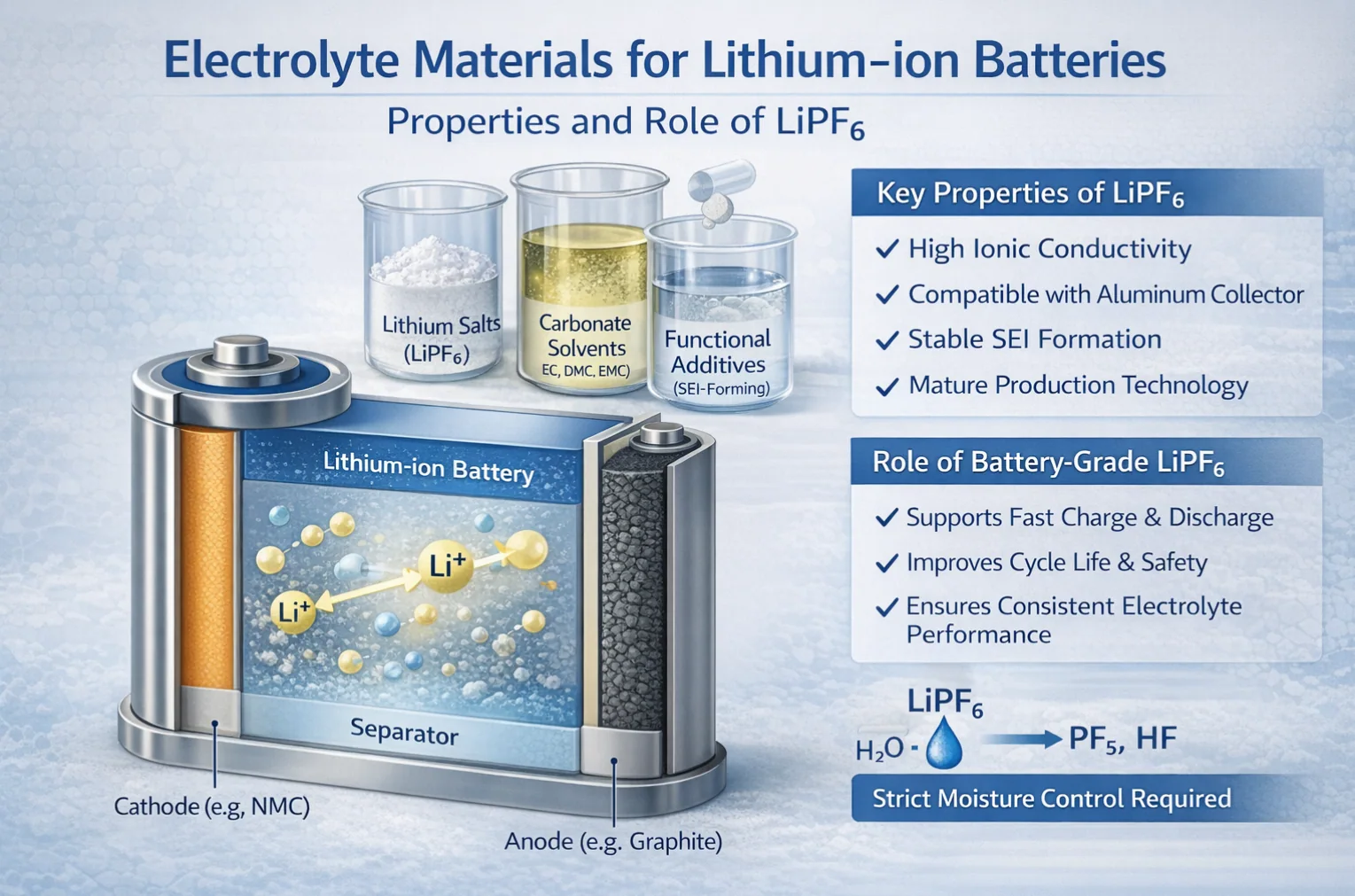
A typical lithium-ion battery electrolyte consists of:
- Lithium salt
- Organic solvent system
- Functional additives
Among all lithium salts used in commercial electrolytes, LiPF₆ (Lithium Hexafluorophosphate) remains the industry standard.
Overview of Electrolyte Materials in Lithium-ion Batteries
Electrolyte materials must satisfy multiple, often competing, requirements:
- High ionic conductivity
- Wide electrochemical stability window
- Chemical compatibility with electrodes
- Thermal and chemical stability
- Controlled moisture sensitivity
These requirements explain why electrolyte formulation is considered one of the most technically demanding areas in battery manufacturing.
LiPF₆: The Core Lithium Salt in Commercial Electrolytes
What Is LiPF₆?
Lithium hexafluorophosphate (LiPF₆, CAS No. 21324-40-3) is a lithium salt widely used in lithium-ion battery electrolytes. It is typically dissolved in carbonate-based solvents such as EC, DMC, EMC, or DEC.
Despite the development of alternative salts, LiPF₆ remains dominant due to its balanced electrochemical and processing properties.
Key Chemical and Physical Properties of LiPF₆
| Property | Description |
|---|---|
| Chemical Formula | LiPF₆ |
| Molecular Weight | 151.9 g/mol |
| Appearance | White crystalline powder |
| Solubility | High solubility in carbonate solvents |
| Ionic Conductivity | Excellent in conventional electrolytes |
| Moisture Sensitivity | Highly sensitive to trace water |
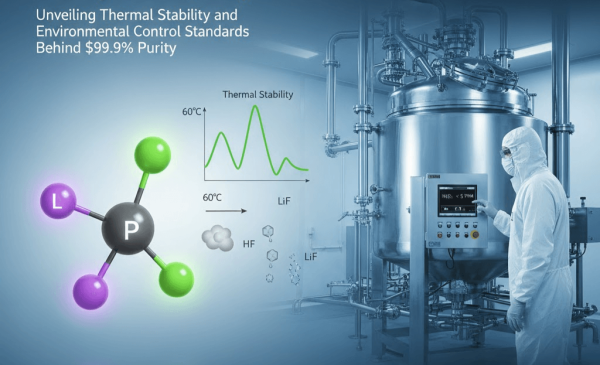
One defining characteristic of LiPF₆ is its moisture sensitivity. In the presence of water, LiPF₆ decomposes to generate PF₅ and HF, which can negatively affect battery safety and performance. As a result, strict moisture control is essential throughout manufacturing, storage, and electrolyte formulation.
Why LiPF₆ Is Still the Industry Standard
Although lithium salts such as LiFSI and LiTFSI have gained attention, LiPF₆ continues to dominate commercial applications for several reasons:
1. High Ionic Conductivity
LiPF₆ provides high lithium-ion mobility in carbonate solvent systems, supporting fast charge and discharge performance.
2. Aluminum Current Collector Compatibility
LiPF₆ forms a stable passivation layer on aluminum current collectors, preventing corrosion during battery operation.
3. Stable SEI Formation
LiPF₆ contributes to the formation of a stable solid electrolyte interphase (SEI) on graphite anodes, which is critical for long cycle life.
4. Industrial Maturity
Compared with newer salts, LiPF₆ benefits from:
- Established production technology
- Stable supply chains
- Proven large-scale application experience
Battery-Grade vs Industrial-Grade LiPF₆
Not all LiPF₆ products are suitable for lithium-ion batteries. Battery-grade LiPF₆ requires much stricter quality control.
| Parameter | Battery-Grade LiPF₆ | Industrial-Grade LiPF₆ |
|---|---|---|
| Purity | ≥ 99.9% | Lower |
| Moisture Content | Ultra-low (ppm level) | Higher |
| Metal Impurities | Strictly controlled | Less controlled |
| Application | Lithium-ion batteries | General chemical use |
For EV batteries and energy storage systems, using non-battery-grade LiPF₆ can lead to capacity fade, gas generation, and safety risks.

LiPF₆ 在不同电池应用中的作用
Electric Vehicle (EV) Batteries
EV batteries demand:
- High energy density
- Long cycle life
- High safety margins
Battery-grade LiPF₆ enables stable electrolyte performance under high voltage and wide temperature ranges.
Energy Storage Systems (ESS)
In stationary energy storage, electrolyte stability and long-term reliability are more critical than extreme power output. LiPF₆-based electrolytes provide proven performance for long-cycle operation.
Consumer Electronics
For portable devices, LiPF₆ supports thin, high-energy-density battery designs with consistent electrochemical behavior.
Quality Control in LiPF₆ Manufacturing
Producing battery-grade LiPF₆ requires advanced fluorochemical expertise and strict process control, including:
- Controlled synthesis environment
- High-purity raw materials
- Advanced purification processes
- Moisture-free packaging systems
- Comprehensive impurity analysis (HF, metal ions)
As a professional fluorochemical material manufacturer, HNNM applies stringent quality standards to ensure LiPF₆ meets the demanding requirements of lithium-ion battery electrolytes.
Storage, Handling and Safety Considerations
Due to its sensitivity, LiPF₆ should be:
- Stored in sealed, moisture-proof containers
- Handled under dry or inert atmosphere
- Transported according to hazardous chemical regulations
Proper handling ensures product stability and consistent electrolyte performance.
Why Choose HNNM for Electrolyte Materials
HNNM specializes in fluorochemical new materials for lithium battery applications, offering:
- Battery-grade LiPF₆ with stable quality
- Strict quality control and testing
- Reliable supply capability
- Technical support for electrolyte formulation
- Custom packaging solutions
Product details:
Lithium Hexafluorophosphate (LiPF₆)
https://www.hnnmnewmaterials.com/products/lithium-battery-materials/lithium-hexafluorophosphate-cas-no-21324-40-3/
FAQ: Electrolyte Materials and LiPF₆
Is LiPF₆ still suitable for next-generation batteries?
Yes. While alternative salts are being researched, LiPF₆ remains the most widely used electrolyte salt in commercial lithium-ion batteries today.
Why is moisture control so critical for LiPF₆?
Moisture causes LiPF₆ decomposition, generating HF that can damage electrodes and reduce battery life.
Can LiPF₆ be customized for different battery systems?
Yes. Battery-grade LiPF₆ can be tailored to meet specific purity, packaging, and application requirements.
Conclusion
Electrolyte materials are a core component of lithium-ion battery technology, directly influencing performance, safety, and longevity. Among available lithium salts, LiPF₆ remains the most reliable and widely adopted choice due to its balanced electrochemical properties and industrial maturity.
With professional fluorochemical manufacturing capabilities, HNNM provides battery-grade LiPF₆ solutions that support the evolving demands of EV, energy storage, and advanced battery systems.