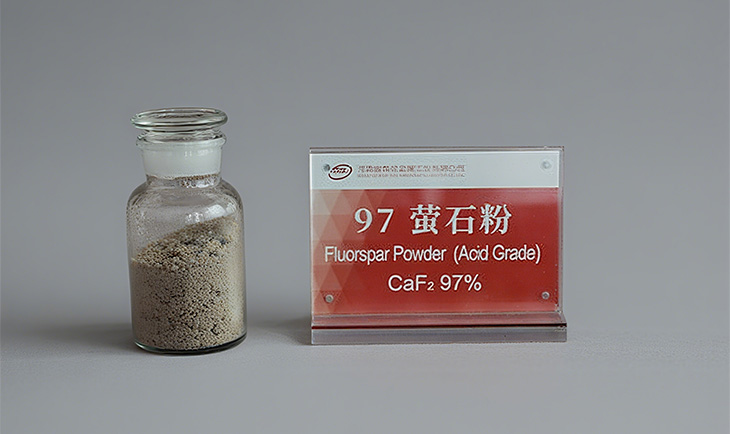
A spec sheet showing 97% CaF₂ confirms that a shipment clears the basic threshold for an acid-grade fluorspar specification. It says little about whether the silica content, moisture level, or batch-to-batch stability will hold up under continuous HF production. This guide walks through the specification parameter by parameter so HF and fluorochemical buyers can judge fit before committing to an order.
Quick Reference: Acid Grade Fluorspar Specification at a Glance
| Parameter | Typical Acid Grade Range | Why It Matters |
|---|---|---|
| CaF₂ | ≥ 97% | Direct yield in HF synthesis |
| SiO₂ | ≤ 1.0% (≤ 0.5% for stricter lines) | Forms SiF₄, lowers HF yield |
| BaSO₄ | Tight, plant-specific limit | Inert deposit, throughput loss |
| S / P | Plant-specific, often ppm-level | Contaminant carryover into HF stream |
| Moisture (H₂O) | Low, dry-basis target | Affects effective CaF₂ per tonne |
| Bulk density | Varies by particle size and compaction | Reactor loading, freight planning |
| Particle size | Supplier-specific, fine powder | Reaction kinetics, feed consistency |
Does Your Process Actually Require Acid Grade Fluorspar Powder?
When Acid Grade Is Necessary
Plants that react fluorspar with sulfuric acid to produce hydrofluoric acid have one commercially viable input: acid grade fluorspar powder. Metallurgical-grade material, even at the upper end of its CaF₂ range, carries impurity levels that are incompatible with HF reaction chemistry and reduce yield well below acceptable margins.
Metallurgical Grade Often Covers Non-Acid Applications
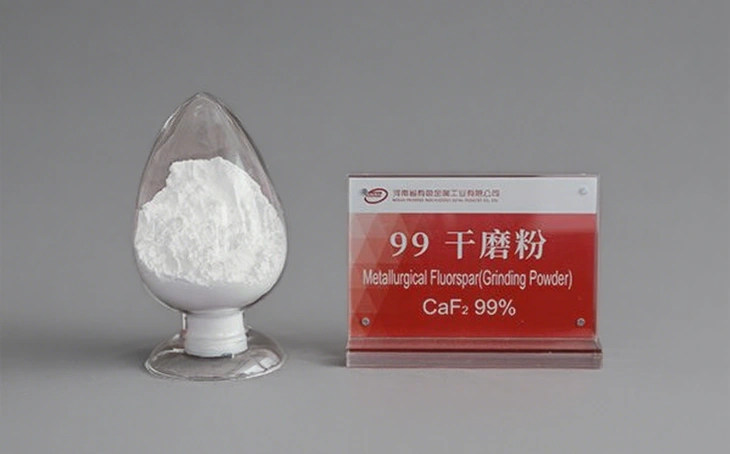
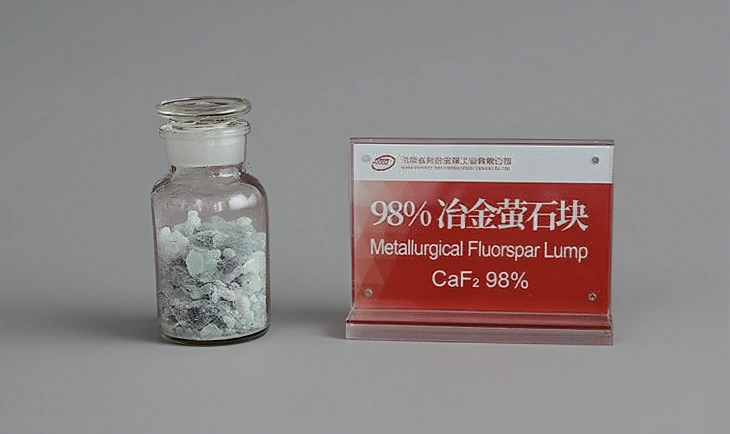
Some buyers default to an acid grade fluorspar specification without first confirming the process actually requires it. Slag conditioning, flux addition, and other non-acid metallurgical uses are typically served well by metallurgical-grade product, generally 65–85% CaF₂, at a lower delivered cost. Our companion guide on fluorspar composition and grade selection covers how CaF₂ content and impurity profile define each commercial grade.
Breaking Down the Acid Grade Fluorspar Specification, Parameter by Parameter
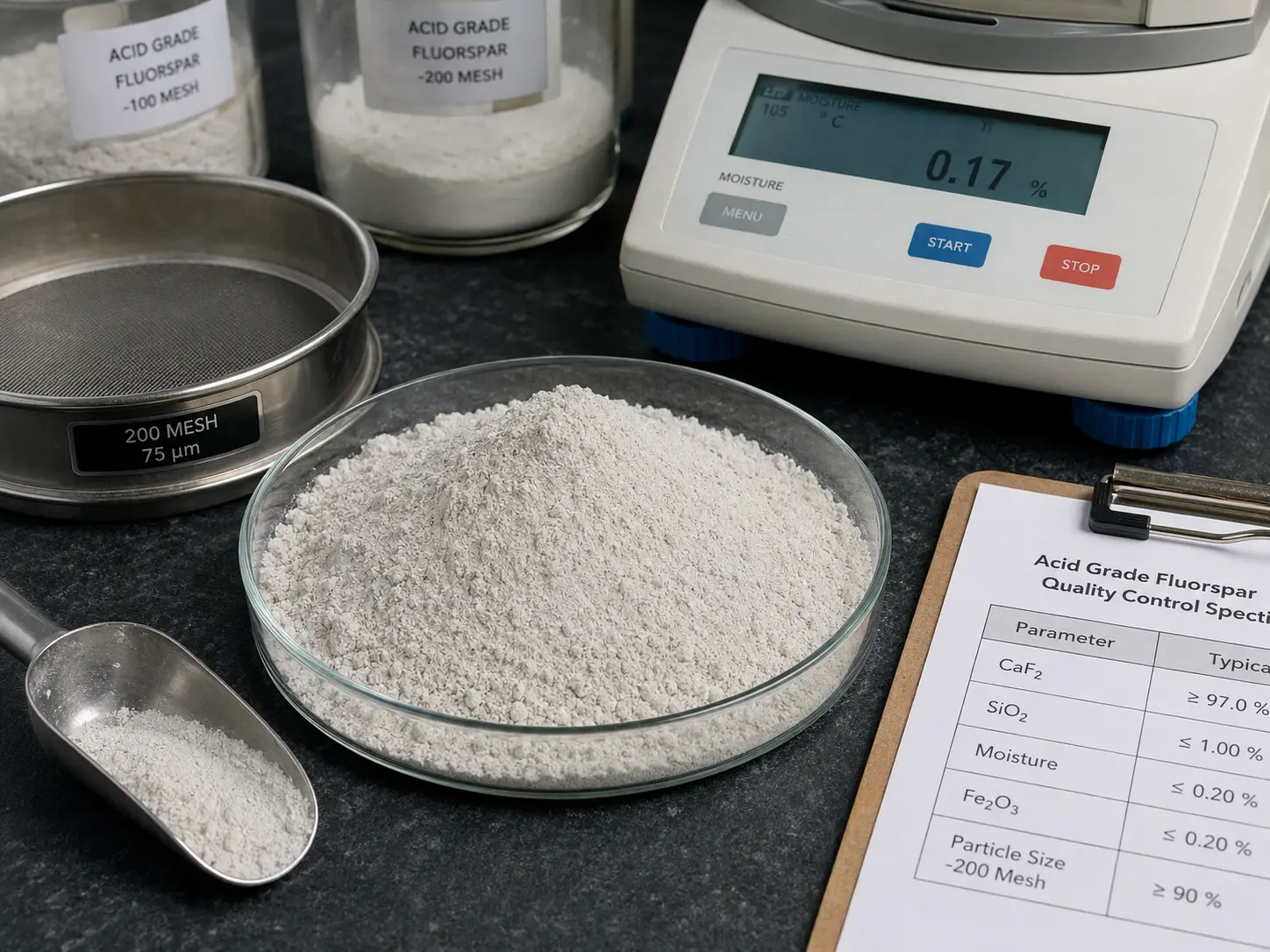
Why 97% CaF₂ Is a Process Threshold, Not a Marketing Figure
The U.S. Geological Survey notes that U.S. trade classifications distinguish acid-grade from metallurgical-grade fluorspar using a 97% CaF₂ threshold, while cautioning that buyer-specific requirements — allowable impurity levels, moisture, particle sizing — can matter just as much in determining whether a shipment actually works in a given plant. Two lots can both clear 97% CaF₂ on paper and still behave differently once they reach your reactor, if their impurity profiles diverge.
What the SiO₂ Limit Protects Against
Silica reacts with sulfuric acid under HF process conditions, forming silicon tetrafluoride (SiF₄) and consuming reactive fluorine that would otherwise become usable HF. Standard specification sheets cap SiO₂ at 1.0%, and stricter fluorochemical lines push that down to 0.5% or lower. Where the downstream purification train has limited tolerance for gas-phase contaminants, SiO₂ deserves closer scrutiny than the reported CaF₂ value.
BaSO₄, Sulfur, and Phosphorus: Easy to Overlook, Hard to Ignore Once They Build Up
BaSO₄ does not react under standard HF process conditions. It accumulates instead, settling as inert material inside the reactor and reducing effective reaction volume over time. A pattern of elevated BaSO₄ across shipments is also a practical signal of inconsistent ore blending at the source. Sulfur and phosphorus carry through into the HF stream at whatever level the feedstock contains, and the acceptable ceiling depends entirely on your downstream tolerance — these limits should be confirmed explicitly rather than assumed to be covered by a general “acid grade” label.
Bulk Density: A Quiet Variable With Real Logistics Consequences
Bulk density rarely appears on preliminary quotations, yet it governs two operational calculations directly: reactor charge volume and freight cost per unit of CaF₂ delivered. Based on fluorite’s true density of roughly 3.18 g/cm³ and the packing behavior typical of fine mineral powders, the bulk density for acid-grade fluorspar powder is commonly estimated around 1.5–1.9 t/m³. The actual figure moves with particle size distribution, compaction, and moisture content, so treat this as an engineering estimate rather than a fixed number. Sizing storage, feed equipment, or container loading should rely on the supplier’s measured value.
Acid Grade, Acidspar, Metallurgical Grade: Sorting Out the Terminology
Trade correspondence often shortens acid grade fluorspar powder to acidspar. The term carries no separate technical meaning of its own; it is simply trader shorthand for the same ≥97% CaF₂ product. A quoted price labeled “acidspar” should be held to the same specification as one labeled “acid grade.”
Fluorspar grade terminology, more broadly, is not governed by a single binding global standard. Domestic Chinese trade typically references national standards covering testing methods and product specifications, while many international buyers work directly from a contract specification negotiated with the supplier. A quotation referencing “acid grade” or “acidspar” without an attached COA is a starting point for negotiation, not a confirmed specification.
Verifying a Supplier’s Acid Grade Fluorspar Specification Before You Commit
What a Complete COA Should Show
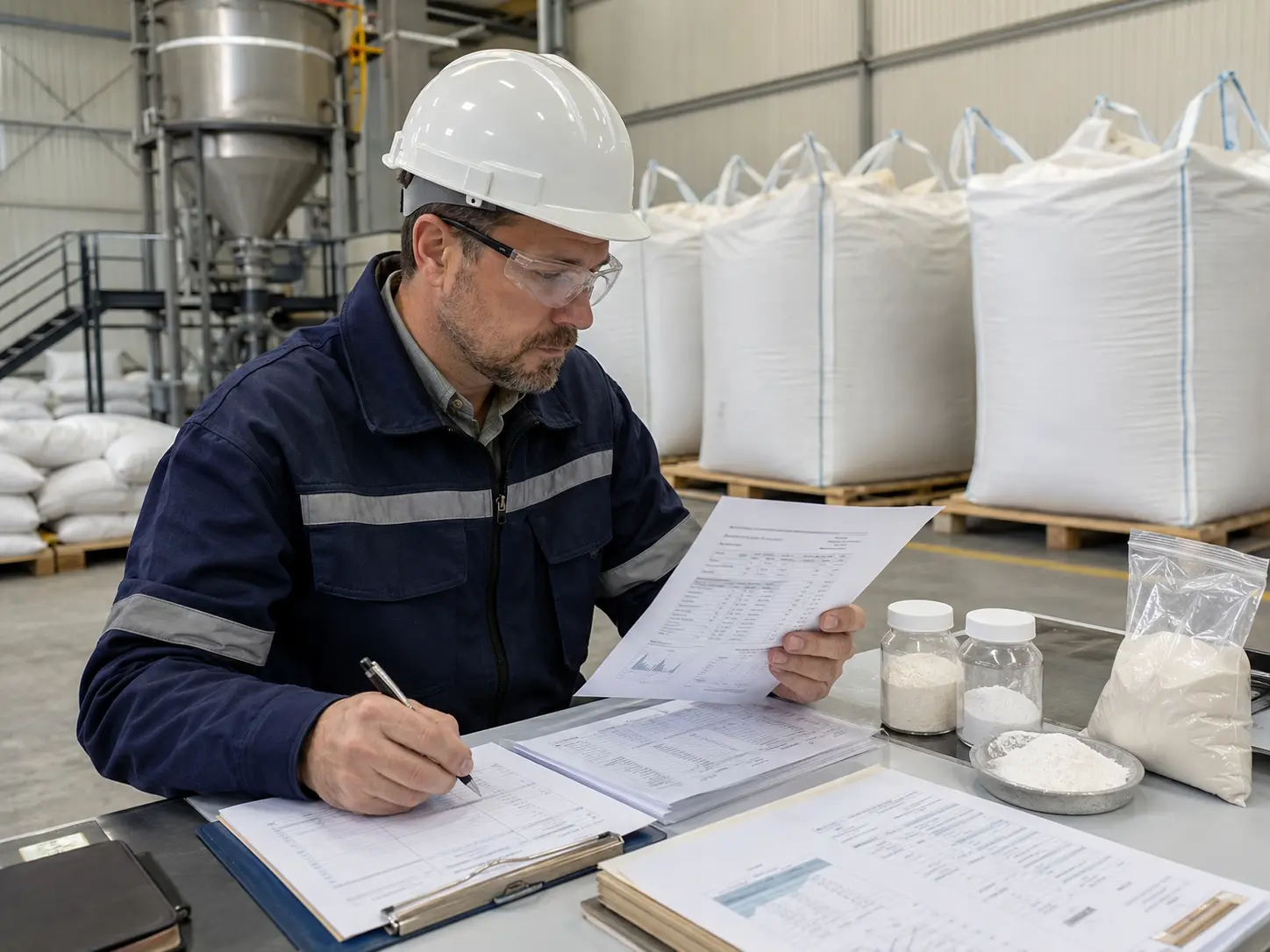
CaF₂, SiO₂, CaCO₃, BaSO₄, S, P, moisture, and particle size all belong on a complete COA for acid-grade material. Cross-check each figure against your process tolerance rather than treating CaF₂ as the only line that matters.
Why One COA Is Not Enough
A single compliant certificate does not guarantee a stable supply. For continuous HF production, ask for COA data from at least three recent production batches and compare how much CaF₂, SiO₂, and BaSO₄ actually move between them. Tight, well-documented variance across batches signals materially lower production risk than a supplier who can only show one certificate at a time.
Which Test Method Generated the Numbers
XRF is fast and widely used for routine supplier quality control. Wet chemistry titration takes longer but delivers higher precision and is the conventional basis for dispute resolution. Results from the two methods on the same sample can differ, with the gap shaped by instrument calibration, sample preparation, and operator technique. Confirm which method produced the COA figures, and name your preferred arbitration method in the purchase contract.
Specification Fit Checklist: Is This Acid Grade Fluorspar Powder Right for Your Plant?
Before confirming an order, check that the quoted specification includes:
- CaF₂ ≥ 97%, with batch-to-batch variance documented rather than asserted
- SiO₂ matched to your reactor’s tolerance (1.0% or tighter)
- Explicit BaSO₄, S, and P limits, not folded into a general grade label
- Moisture content with dry-basis reconciliation
- Bulk density figures relevant to your storage and feed system design
- Disclosed test method (XRF or wet chemistry) with a third-party arbitration option
- For a new supplier, a trial batch is evaluated against your own reactor performance before any volume commitment
Specification Fit Decides This, Not the Grade Label
An acid grade fluorspar specification only becomes useful to a buyer once every parameter has been checked against actual process tolerance, CaF₂ included but not alone. “Acid grade” and “acidspar” describe a starting category. Neither substitutes for a verified COA, a confirmed test method, and batch consistency backed by data rather than assurance. Buyers who request the full specification before placing a first order are in a stronger position to avoid yield losses, reactor fouling, and disputes once volume is on the line.
Frequently Asked Questions
What happens if acid grade fluorspar runs slightly below 97% CaF₂?
A shortfall below 97% generally means a higher relative share of impurities, particularly SiO₂, which increases competing reactions and lowers HF yield per tonne processed. Whether a marginal shortfall is workable depends on your plant’s purification capacity and tolerance for reduced yield. Evaluate it against your own process model rather than applying a fixed rejection line.
What is the bulk density of fluorspar powder, and why do I need it before ordering?
Bulk density for acid-grade fluorspar powder is typically estimated in the 1.5–1.9 t/m³ range, based on fluorite’s true density of about 3.18 g/cm³ and standard packing behavior for fine mineral powders. The figure shifts with particle size and moisture, so it should be confirmed with the supplier rather than assumed. You need it to size storage silo capacity, reactor charge volume, and container or bulk freight loading — chemical specifications can be fully met, and a shipment can still create a logistics problem if the bulk density assumption is off.
How is acid grade fluorspar produced, and does the method affect quality?
Acid grade fluorspar comes from froth flotation beneficiation of run-of-mine ore. Crushing and grinding liberate CaF₂ from the surrounding gangue, and flotation reagents then selectively float CaF₂ particles away from silica, carbonate, and sulfide minerals. The resulting concentrate is dewatered and dried to the final powder specification. Flotation performance depends heavily on the ore’s original mineralogy: deposits with finely intergrown impurities are harder to upgrade to ≥97% CaF₂ with low SiO₂, which is part of why acid grade pricing varies between sources even at the same nominal CaF₂ percentage.
Can two suppliers’ 97% CaF₂ products be treated as interchangeable?
Not without verification. Matching headline numbers does not guarantee matching impurity profiles, particle size distribution, or batch stability. Before substituting a new supplier into an existing process, compare full COA data across both products, and, where possible, run a trial batch to confirm reactor performance before committing to volume.
Henan Non-Ferrous Metals Industry Co., Ltd. is an authorized trading subsidiary of Duofluoride Chemicals Co., Ltd. (Shenzhen Stock Exchange: 002407), a globally recognized fluorochemical manufacturer. We supply acid grade fluorspar powder with documented multi-batch COA data to HF producers and fluorochemical plants worldwide. For full specification sheets, samples, or supply inquiries, contact us at: [email protected]