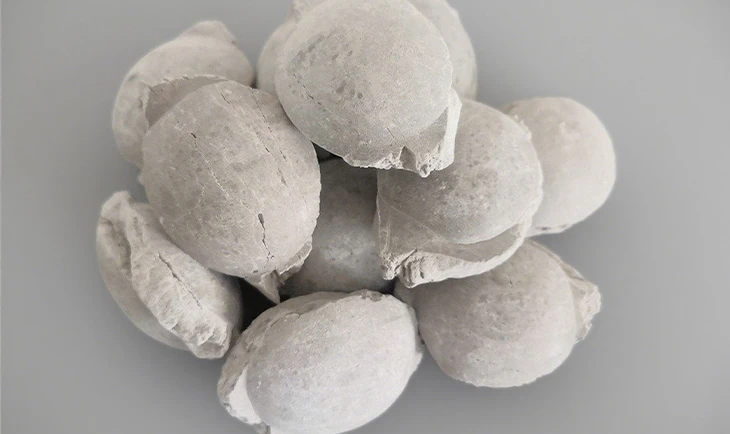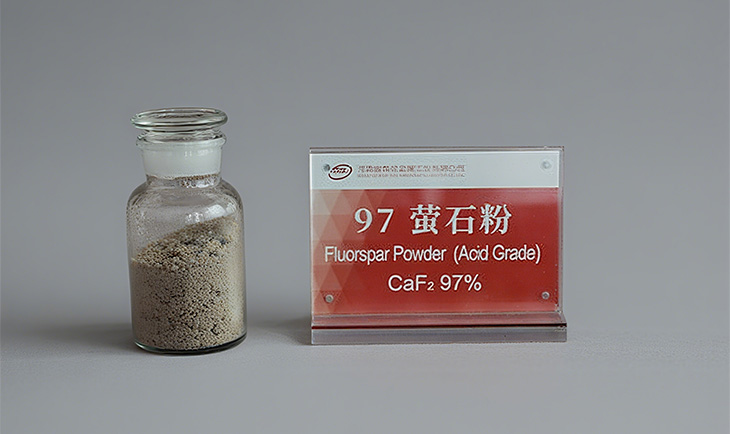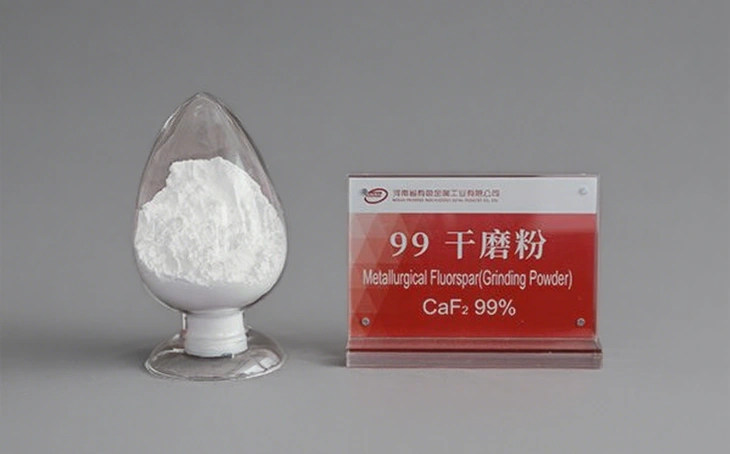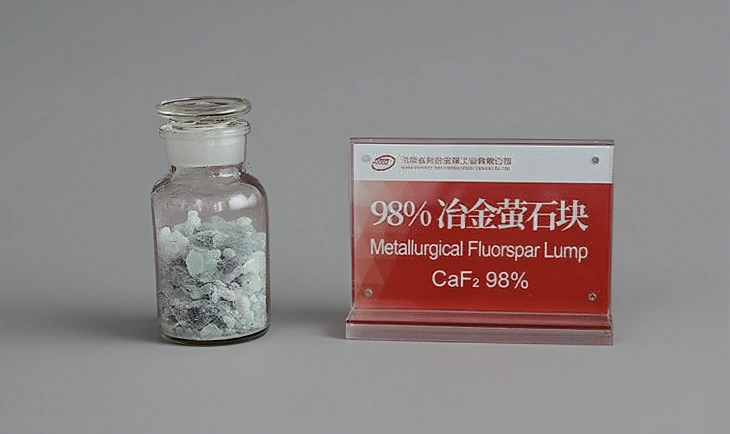
Acid grade fluorspar uses are closely tied to hydrogen fluoride production. In an HF plant, acid grade fluorspar is not simply a high-CaF₂ mineral powder. It is a process feedstock that affects dry-feed control, sulfuric acid consumption, reaction contact, gas quality, purification load, and downstream fluorochemical stability.
A material may qualify as acid grade, yet still create feeding, acid-balance, or gas-treatment issues if its moisture, particle size, or impurity profile shifts. The real question for buyers is how the material behaves under their own storage, feeding, and reaction conditions.
This guide reviews acid grade fluorspar uses from the plant side, focusing on how feedstock properties translate into feeding stability, reaction control, gas treatment load, and downstream HF quality.
Why HF Production Is the Main Use of Acid Grade Fluorspar
The primary industrial use of acid-grade fluorspar is hydrogen fluoride production, including anhydrous hydrogen fluoride and hydrofluoric acid. Acid grade fluorspar provides the CaF₂ source required for reaction with sulfuric acid. The HF produced from this route becomes an upstream intermediate for refrigerants, fluoropolymers, aluminum fluoride, synthetic cryolite, metal fluorides, and other fluorochemicals.
A practical value chain is:
acid grade fluorspar → HF / hydrofluoric acid → fluorochemical products
This is why acid grade fluorspar uses should be evaluated beyond the grade name. A buyer needs to know not only whether the material contains enough CaF₂, but also whether the full feedstock profile supports stable HF production.
For external reference, buyers can use U.S. Geological Survey fluorspar data for market classification background and PubChem Calcium Fluoride information for basic chemical identity.
How Does HF Production from Fluorspar Work?
HF production from fluorspar is generally based on the reaction between calcium fluoride and sulfuric acid:
CaF₂ + H₂SO₄ → CaSO₄ + 2HF
In industrial production, acid-grade fluorspar powder is mixed with concentrated sulfuric acid and heated in reaction equipment such as rotary kiln systems. The reaction generates hydrogen fluoride gas and calcium sulfate residue. Depending on the plant design, HF gas is then purified, condensed, or absorbed to produce anhydrous HF or aqueous hydrofluoric acid.
The route from fluorspar to HF is not a single isolated reaction. It includes receiving, storage, powder conveying, metered feeding, sulfuric acid mixing, heated reaction, gas treatment, residue discharge, and downstream HF use. Small differences on a COA can become more visible once the material enters this chain.
How Feedstock Properties Affect HF Production
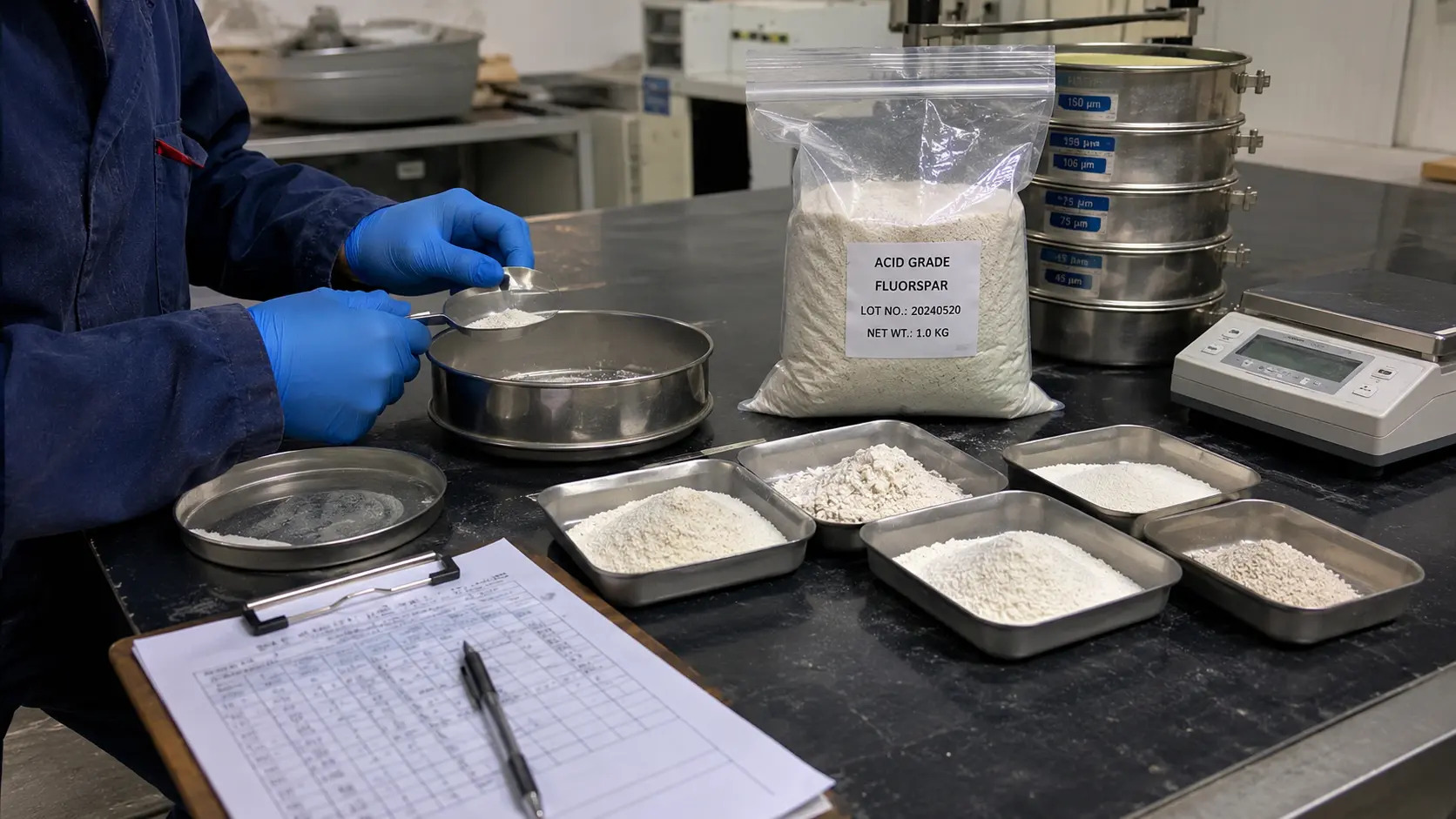
Moisture: Dry-Feed Basis and Powder Behavior
Moisture is not only a storage issue. It changes both powder handling and the effective dry basis of the feed.
If acid grade fluorspar retains excess surface moisture or is exposed to moisture during transport and storage, the powder may become less free-flowing. This can affect unloading, hopper discharge, screw feeding and dosing stability. In continuous HF production, unstable powder flow can disturb the feed rate even when the chemical composition is acceptable.
Moisture also affects the actual CaF₂ input per tonne of material. A wetter shipment delivers less dry fluorspar at the same nominal weight. If the plant calculates sulfuric acid dosage or feed balance without correcting for moisture, the effective CaF₂-to-acid ratio may shift. This can affect reaction control and HF output stability.
Procurement review point: confirm whether moisture is reported on a wet or dry basis, compare recent batch values, and review whether the packaging can keep the powder stable before use.
Particle Size: Reaction Contact Versus Feeding Stability
Particle size creates a balance between reaction contact and powder handling.
Finer particles increase available surface area for sulfuric acid contact, but this advantage only helps when the feeding system can handle the powder steadily. Powder that is too fine may create dusting, handling loss, poor flow, feeder instability or agglomeration. Coarser particles may flow better in some systems, but lower surface area can reduce contact efficiency and may require different residence time or mixing conditions.
This means the ideal particle size is not universal. It depends on the plant’s feeding equipment, acid mixing method, reactor design and operating preference. In HF production, “powder” is not enough as a specification. Buyers need a particle size distribution that matches the plant’s handling and reaction system.
Procurement review point: request particle size distribution, not just product form. If the distribution differs from the current material, a trial batch is safer than direct bulk substitution.
SiO₂: HF Consumption and Silicon-Fluorine By-Products
SiO₂ is one of the most important impurities in acid grade fluorspar for HF production. Its impact is not limited to a number on the specification sheet.
In the HF reaction environment, silica-related impurities may consume part of the generated HF and form silicon-fluorine by-products such as SiF₄. This has two practical effects. First, part of the fluorine value is diverted away from useful HF output. Second, silicon-fluorine species can increase the burden on gas treatment, absorption, or purification systems.
For plants with strict HF quality requirements, SiO₂ control becomes a production issue, not only a purchasing issue. A small change in SiO₂ may look minor on a COA, but in continuous operation, it can affect yield, purification load, and downstream consistency.
Procurement review point: compare actual SiO₂ values across multiple batches and confirm the plant’s tolerance with the technical team.
CaCO₃: Sulfuric Acid Consumption and Acid Balance
CaCO₃ affects HF production through acid consumption. Carbonate impurities react with sulfuric acid and consume acid that would otherwise be available for CaF₂ conversion. This can increase sulfuric acid consumption and change the reaction baseline.
The issue is not only chemical purity. Higher carbonate content can affect acid balance, operating economy, and process adjustment. If the plant runs on a carefully controlled acid-to-fluorspar ratio, carbonate variation may force operators to adjust acid dosage or accept lower reaction efficiency.
Procurement review point: do not compare CaF₂ alone. Review CaCO₃ together with CaF₂ and sulfuric acid consumption expectations.
Trace Impurities: Sensitivity Depends on Final HF Use
Trace impurities such as S, P, As, and Fe do not affect every HF plant in the same way. Their importance depends on the purification design and downstream application.
A plant producing general industrial HF may focus mainly on stable yield and common impurity control. A plant supplying higher-purity fluorochemical production may require stricter limits because trace impurities can increase purification load or affect downstream acceptance.
Procurement review point: define the final HF application before approving the fluorspar. The stricter the downstream requirement, the more important trace impurity control becomes.
Batch Variation: The Hidden Risk in Continuous Production
One qualified COA does not prove long-term process fit. HF plants run on stable operating baselines. If moisture, SiO₂, CaCO₃, particle size, or trace impurities change between shipments, operators may need to adjust feeding, acid ratio, reaction control or gas treatment conditions.
Batch variation is especially important when replacing an existing source. A new material may meet the same headline CaF₂ value but behave differently because of physical properties or impurity profile.
Procurement review point: request recent multi-batch COA data and compare variation, not only average values.
Why Reaction Temperature Should Be Confirmed by Engineers
Many buyers search for “fluorspar sulfuric acid reaction temperature for HF production” to judge whether a material will match their plant. Public references describe heated reaction systems, often involving rotary kilns, but exact temperature, acid ratio, residence time, kiln design, feed rate, and gas treatment configuration vary by plant.
Reaction temperature should not be used as a universal purchasing standard. Commercial documents can provide COA data, SDS, physical properties, packaging details, and samples, but final process suitability should be confirmed by the buyer’s engineering team.
What Can an SDS Tell Buyers?
An SDS supports safety, storage, transport, and EHS review. For calcium fluoride/fluorspar products, it helps buyers confirm chemical identity, CAS number, physical appearance, dust precautions, storage guidance, and transport information.
However, an SDS cannot prove HF process suitability. It should not be used to infer CaF₂ grade, impurity limits, moisture level, particle size, or acid-grade acceptance. For production approval, buyers still need COA or specification data showing CaF₂, SiO₂, CaCO₃, moisture, particle size, and process-sensitive impurities.
| Document | Main Purpose | What It Supports |
|---|---|---|
| SDS | Safety, storage and transport review | EHS, import, warehouse and dust-control assessment |
| COA / Specification | Chemical and physical quality review | HF process fit, batch approval and purchasing decision |
When Should Buyers Request a Trial Batch?
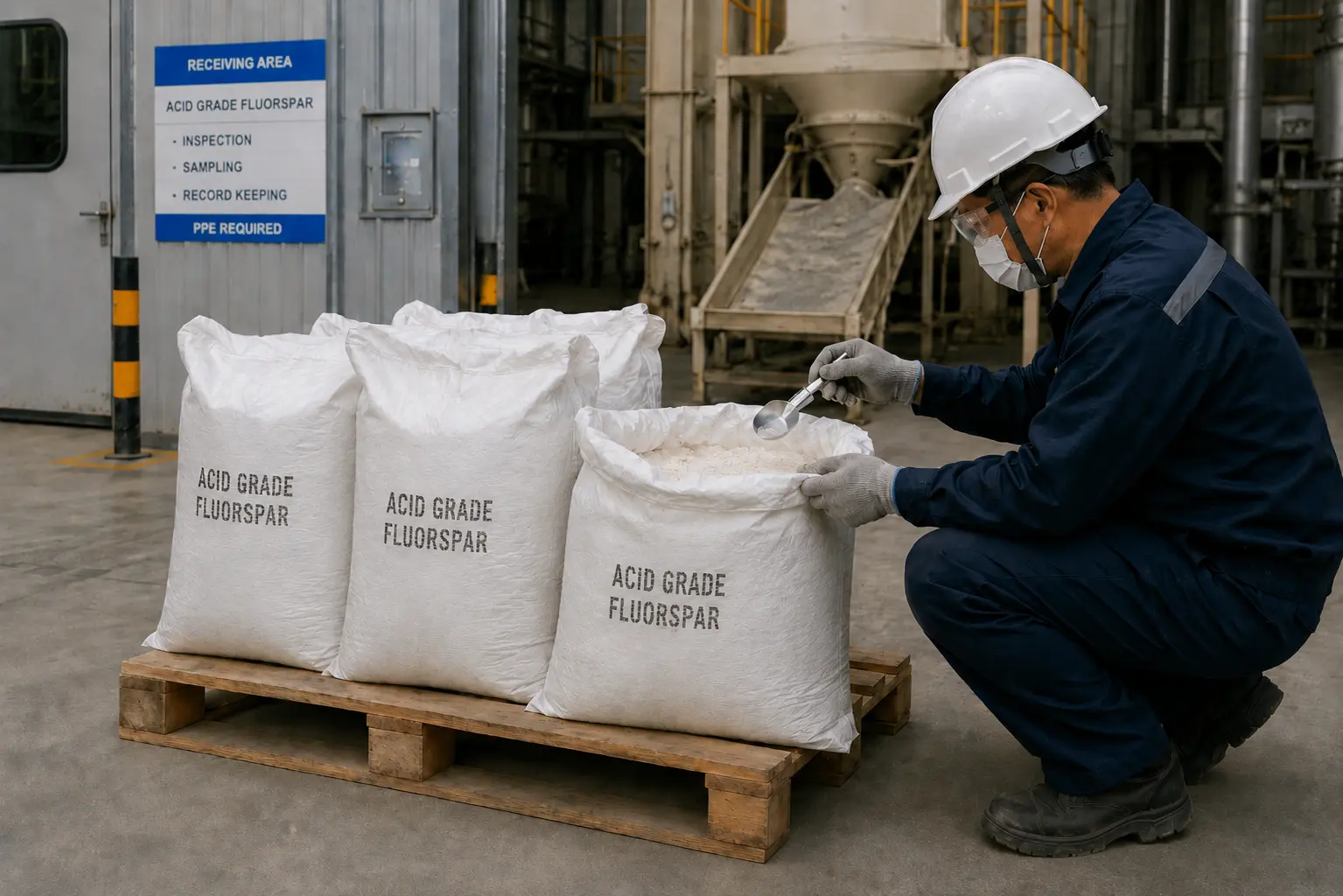
A trial batch is recommended when paper data cannot fully predict operating behavior. This is especially important when:
- changing commercial source or ore source;
- using a different beneficiation route;
- switching to a different particle size distribution;
- moisture or SiO₂ variation is a concern;
- The plant runs continuous HF production;
- downstream HF quality requirements are strict;
- The existing feeding system has limited tolerance for powder changes.
A trial batch connects specification data with real plant behavior. It helps confirm whether the material can move from document approval to bulk supply.
Fluorspar to Fluorine: A Value Chain, Not a One-Step Conversion
The phrase “fluorspar to fluorine” should be understood as a value-chain expression, not a direct one-step conversion. In most industrial routes, fluorspar is first converted to HF. HF then becomes the intermediate for fluorine-containing chemicals and, in some downstream routes, elemental fluorine-related production.
A practical route is:
fluorspar to HF → HF to fluorochemicals → fluorine-based products
This wider value chain is why feedstock control at the fluorspar stage can influence more than the first HF reaction step.
FAQ
What are the main acid grade fluorspar uses?
The main acid grade fluorspar uses are HF production, hydrofluoric acid production and upstream supply for fluorochemical manufacturing. It provides the CaF₂ source for producing hydrogen fluoride, which is then used in fluorocarbons, fluoropolymers, aluminum fluoride, synthetic cryolite, and other fluorine-based products.
What does fluorspar to HF mean for buyers?
Fluorspar to HF means evaluating acid-grade fluorspar as a production feedstock. Buyers should review moisture, particle size, SiO₂, CaCO₃, trace impurities, and batch consistency, not only the acid grade name.
Why is SiO₂ important in acid grade fluorspar?
Silica-related impurities may consume generated HF and form silicon-fluorine by-products such as SiF₄. This can reduce effective HF output and increase gas treatment or purification burden.
Is the reaction temperature enough to judge whether fluorspar fits HF production?
No. The phrase “fluorspar sulfuric acid reaction temperature for HF production” is useful for technical research, but actual temperature, acid ratio, residence time, and kiln design vary by plant. Final suitability should be confirmed by engineers.
When should a buyer request a trial batch?
A trial batch is recommended when changing source, changing particle size distribution, using the material in continuous HF production, or serving downstream applications with strict HF quality requirements.
Conclusion
Acid grade fluorspar is mainly used in HF production, but the grade name alone does not prove process fit. Moisture changes dry-feed control and powder behavior. Particle size affects both reaction contact and feeding stability. SiO₂ may consume generated HF and increase the purification burden. CaCO₃ consumes sulfuric acid and affects the acid balance. Trace impurities and batch variation can influence final HF quality and production stability.
The key purchasing question is not only:
Does this material meet the specification?
The more practical production question is:
Can this material run steadily in our HF process?
Before bulk purchasing, buyers should review recent COA data, check the SDS for handling and storage requirements, confirm process-sensitive indicators with engineers, and request a trial batch when process risk is high.
Henan Non-Ferrous Metals Industry Co., Ltd. is an authorized trading subsidiary of Duofluoride Chemicals Co., Ltd. (Shenzhen Stock Exchange: 002407). Duofluoride is a leading fluorochemical manufacturer with around 30% of global LiPF6 capacity and strong synthetic cryolite supply capability. For acid grade fluorspar COA, SDS, sample request or HF production application review, contact us at [email protected].