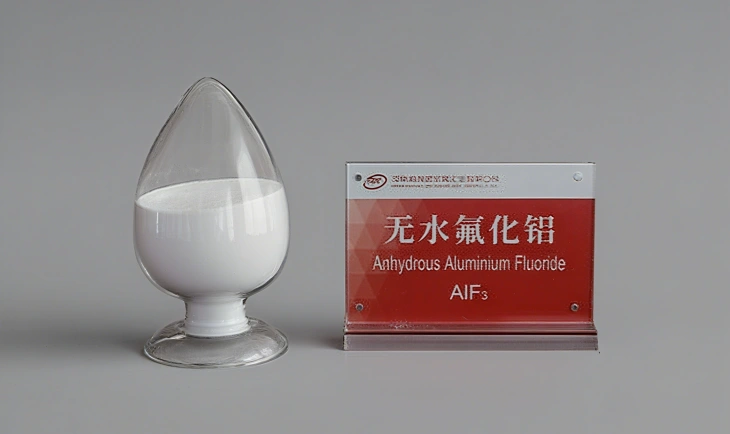
For aluminum fluoride, hydrofluoric acid, synthetic cryolite, and other fluorochemical buyers, fluorspar procurement is not only a price comparison. A lower-cost source may still create higher total risk if CaF₂ content varies, impurity levels are unstable, moisture control is poor, particle size is unsuitable, packaging protection is insufficient, or delivery documents do not match the actual batch.
Therefore, fluorspar procurement should not be treated as a simple mineral inquiry. Buyers should evaluate the material based on downstream application requirements, technical specifications, COA / TDS / SDS documentation, sample testing, trial order feedback, batch records, and the supplier’s long-term supply management capability.
Why Fluorspar Procurement Risk Is More Than Price and CaF₂ Content
Low Purchase Price Does Not Equal Low Total Cost of Use
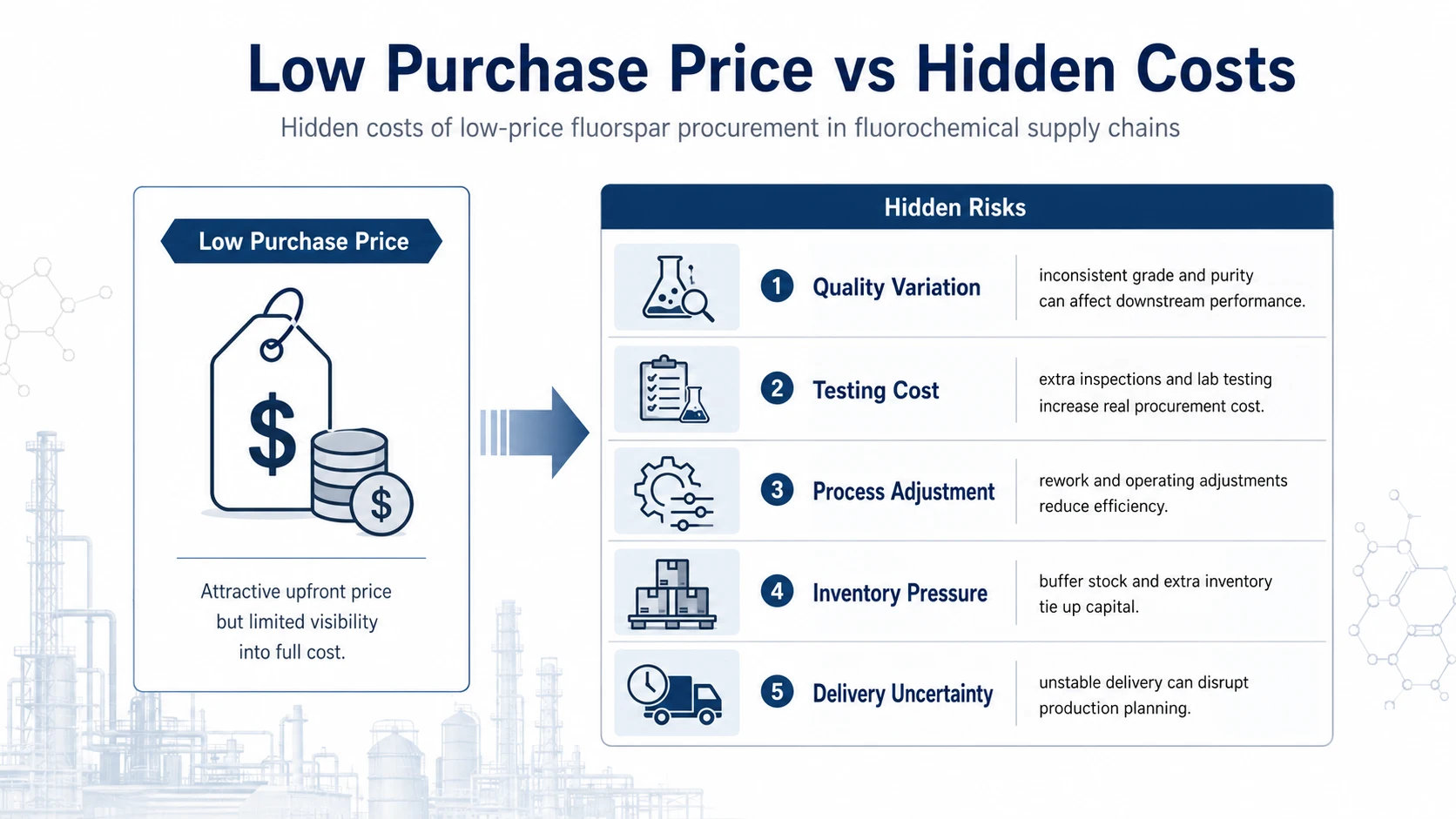
In industrial procurement, a low unit price does not necessarily mean a lower total cost. For aluminum fluoride and related fluorochemical supply chains, the real cost of fluorspar includes purchase price, effective fluorine utilization, impurity handling, testing costs, storage and transport loss, process adjustment costs, and delivery risk.
If a lower-priced fluorspar product has unstable CaF₂ content, higher impurity levels, inconsistent moisture control, or unsuitable particle size, downstream users may need to increase testing frequency, adjust production parameters, raise safety stock, or accept lower operating efficiency and delivery uncertainty.
The core purchasing question should not be which batch has the lowest price, but whether the material can remain technically suitable and commercially reliable over repeated use.
A Qualified Single Batch Does Not Prove Long-Term Batch Stability
A single test result only shows that one batch meets certain requirements under specific testing conditions. It does not prove that later batches will remain consistent.
As a mineral raw material, fluorspar quality may be affected by ore source, beneficiation process, inventory management, blending method, and transport conditions. For continuous production users, procurement security depends less on one qualified report and more on whether quality variation across multiple batches remains controllable.
In long-term industrial supply, procurement risk often becomes visible after the first qualified batch. Differences in moisture control, particle size consistency, packaging strength, and document accuracy may appear during repeated shipments. This is why buyers should evaluate fluorspar suppliers through batch records, trial orders, and delivery execution, not only through quotation sheets or one-time test results.
Buyers should review the following factors:
| Review Area | Procurement Focus |
|---|---|
| Batch stability | Whether CaF₂, impurities, moisture and particle size remain consistent across batches |
| Testing consistency | Whether CaF₂, impurities, moisture, and particle size remain consistent across batches |
| Supply continuity | Whether periodic procurement requirements can be supported |
| Deviation handling | Whether retesting, communication and corrective action are available when deviations occur |
The purpose of this review is to identify the risk source: one qualified batch does not equal long-term stability.
Ignoring Impurities, Moisture, Particle Size, and Delivery Conditions Can Increase Hidden Costs
CaF₂ content is a basic indicator in fluorspar procurement, but it is not the only factor that determines suitability. For fluorochemical applications, SiO₂, CaCO₃, moisture, particle size, moisture-proof packaging, and delivery conditions can also affect actual use.
Impurity variation may increase downstream reaction and quality control pressure. High moisture may lead to storage, caking, weighing, and feeding issues. An unsuitable particle size may affect material flowability and contact efficiency. Poor packaging or delivery control may increase the risk of moisture absorption, breakage, contamination, or batch confusion during long-distance transport.
Therefore, procurement decisions should not stop at whether the material meets a content requirement. Buyers also need to assess whether the material is suitable for the target process, packaging method, storage conditions, and delivery cycle.
Key Specifications Buyers Should Check Before Purchasing Fluorspar
Define the Downstream Application and Production Requirements First
Before purchasing fluorspar, buyers should first clarify the intended application. Different applications may require different grades, CaF₂ levels, impurity limits, moisture ranges, particle size distributions, and packaging methods.
Fluorspar used for metallurgical fluxing, fluorochemical raw materials, hydrofluoric acid production, aluminum fluoride supply chains, or other fluoride products may involve different procurement priorities.
Industry references generally distinguish fluorspar by grade and application direction. Acid-grade fluorspar is commonly associated with hydrofluoric acid and fluorochemical production, while metallurgical-grade fluorspar is more often used in fluxing and metallurgical applications. This is why buyers should confirm the intended use before comparing quotations or technical data sheets.
Buyers should confirm:
- whether the target use is metallurgical, fluorochemical, or another industrial application;
- whether acid-grade, metallurgical-grade, or a specific particle size is required;
- whether the existing production line has clear limits for impurities, moisture, or particle size;
- whether the packaging method is suitable for storage, feeding, and long-distance transport;
- whether the demand is a one-time purchase or a periodic supply requirement.
Only after the application is clear can technical specifications be reviewed with practical meaning.
Convert CaF₂, Impurities, Moisture, and Particle Size into Procurement Acceptance Standards
Professional procurement should not rely only on quotation sheets or typical values. Key parameters should be converted into clear acceptance standards.
| Specification Item | Procurement Review Focus | Risk Control Value |
|---|---|---|
| CaF₂ content | Minimum level or target range | Evaluates the effective fluorine source level |
| SiO₂ / CaCO₃ and other impurities | Acceptable impurity range | Reduces downstream reaction and quality control pressure |
| Moisture | Upper limit and testing method | Jumbo bag, liner, and moisture-proof requirements |
| Particle size | Required particle size range and screening requirement | Improves feeding and handling stability |
| Packaging method | Jumbo bag, liner and moisture-proof requirements | Reduces transport and storage risk |
| Batch deviation | Allowable variation range for repeated supply | Controls continuous procurement risk |
Typical values help buyers understand the normal property range of a product. Acceptance standards determine whether an actual delivered batch meets the purchasing requirement. These two concepts should not be confused.
Confirm Whether COA, TDS, and SDS Correspond to the Actual Delivered Batch
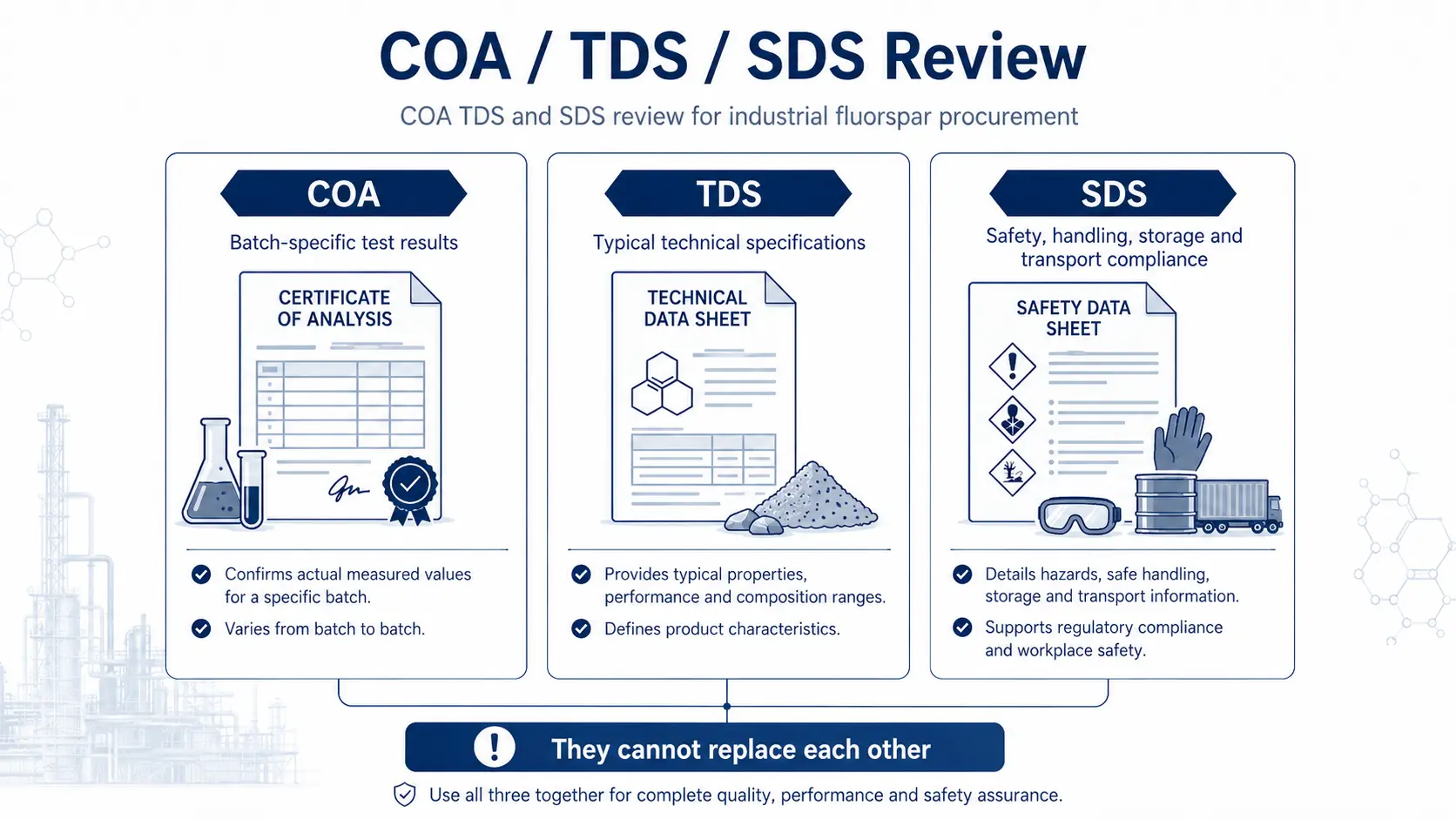
Quality document review is a critical part of fluorspar procurement risk control. COA, TDS, and SDS serve different purposes and cannot replace one another.
COA provides batch-specific test results and should correspond to the actual delivered batch, package number, or shipment information. TDS describes typical technical properties and application scope. SDS provides product identification, safe handling, storage conditions, exposure control, transport classification, and regulatory information for safety and compliance management.
In fluorspar procurement, the value of SDS is not to prove product grade, but to support safety, storage, handling, and trade compliance review. A standard SDS should clearly state product identification, main composition, handling requirements, storage conditions, exposure controls, transport classification, and relevant regulatory information.
For Calcium Fluoride / Fluorspar, an SDS may commonly include CAS No. 7789-75-5, molecular formula CaF₂, dust control guidance, storage recommendations, and transport classification information. However, the exact SDS content should always be checked based on the supplier’s latest document and the buyer’s local compliance requirements.
Buyers can use SDS information to check whether the supplier’s documentation is complete, whether the product identification is clear, and whether packaging and storage requirements are suitable for long-distance transport and on-site warehousing.
However, SDS cannot replace batch quality documents. Whether the fluorspar meets procurement requirements should still be confirmed through COA, TDS, actual batch test records, and, when necessary, retesting.
Why Sample Testing and Trial Orders Are Necessary Before Long-Term Procurement
Sample Testing Provides Initial Verification of Specification and Application Suitability
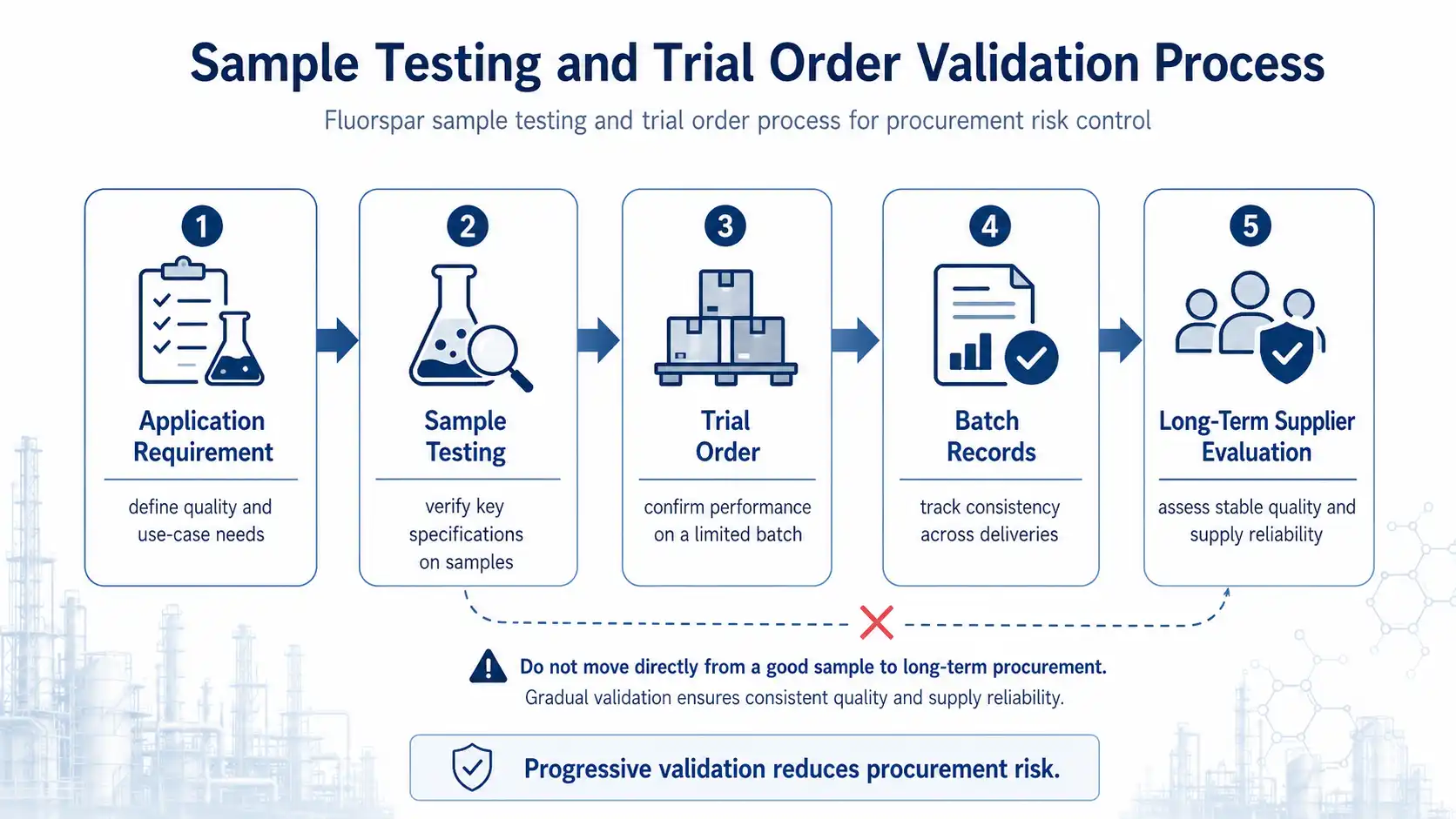
Sample testing is an initial step in supplier qualification and procurement risk control. Its role is to verify product specifications and application suitability, not to prove long-term batch stability.
During sample testing, buyers should confirm:
- whether the sample source is consistent with future supply;
- whether the sample test covers CaF₂, impurities, moisture and particle size;
- whether sample packaging and storage may affect test results;
- whether the testing method is consistent with the buyer’s internal standards;
- whether the supplier can explain the relationship between the sample and future bulk supply.
If the sample passes testing but the source, process, packaging, or testing method changes during bulk delivery, procurement risk remains.
Trial Orders Verify Storage, Feeding and Delivery Stability
The value of a small trial order is not only to repeat laboratory testing. It helps verify material performance under real procurement and operating conditions.
Three areas should be observed during a trial order.
First, storage performance. Packaging should remain intact, moisture protection should be effective, and the material should not show obvious caking, dampness, or contamination.
Second, feeding performance. Particle size, flowability, and dust behavior should match site handling requirements and should not negatively affect weighing, conveying, or feeding consistency.
Third, delivery performance. The supplier should deliver according to the agreed time, packaging, documentation, and trade terms. COA, SDS, packing list, bill of lading, and other documents should remain clear and consistent.
Sample testing answers whether the material is initially suitable. A trial order answers whether the product works in real storage, handling, and delivery conditions.
Batch Records and Deviation Feedback Should Be Established Before Long-Term Procurement
Before long-term procurement, buyers should establish batch records and deviation feedback mechanisms to evaluate whether a supplier has the foundation for consistent supply.
| Management Item | Control Purpose |
|---|---|
| Batch test records | Track quality variation trends |
| Arrival inspection records | Monitor packaging, moisture protection, breakage and contamination |
| Usage feedback records | Monitor packaging, moisture protection, breakage, and contamination |
| Specification deviation records | Assess quality control stability |
| Deviation communication mechanism | Improve response and corrective action efficiency |
The purpose of this stage is verification. Through samples, trial orders, batch records, and feedback, procurement decisions move from one-time testing to continuous validation.
How to Evaluate a Long-Term Fluorspar Supplier
Ability to Maintain Stable Supply, Delivery Cycle, and Batch Quality
A supplier’s long-term value does not depend only on whether it can provide one qualified batch. It depends on whether it can continuously organize a stable supply, maintain delivery schedules, and control quality variation across multiple batches.
Buyers should assess whether the supplier can:
- match the required grade and particle size according to customer needs;
- maintain a relatively stable supply rhythm;
- control specification variation across repeated shipments;
- communicate delivery changes or supply risks in advance;
- support periodic purchasing plans.
Stable supply capability is not the same as simple inventory availability. It reflects supply organization, quality selection, delivery coordination, and deviation response capability.
Quality Control, Batch Management, and Traceability Capability
A reliable fluorspar supplier should have a clear quality control process, including source selection, specification testing, batch numbering, pre-shipment confirmation, document filing, and customer feedback tracking.
Buyers can evaluate quality management capability through the following questions:
- Can the COA correspond to the actual delivered batch?
- Are testing items, testing methods, and testing frequency clearly explained?
- Can key parameters be controlled according to customer requirements?
- Can the supplier trace the source and quality records of different batches?
- Is there a retesting or handling plan when specification deviations occur?
This section focuses on supplier evaluation: whether the supplier can continuously apply quality requirements through batch management.
Packaging, Moisture Protection, Shipping, and Export Document Support
Although fluorspar is an industrial mineral raw material, packaging, storage, shipping, and documentation directly affect procurement risk. In cross-border procurement, long-distance transport, port handling, warehouse conditions, and customs documents can all influence final cargo condition and purchasing efficiency.
SDS documents usually provide guidance on dust control, storage conditions, personal protection, and transport classification. Even when the product is not classified as dangerous goods under relevant transport categories, buyers should still review packaging strength, moisture protection, dust control, and document completeness.
Buyers should confirm:
- whether the packaging is suitable for long-distance transport and on-site storage;
- whether moisture-proof, damage-resistant, and contamination-control measures are available;
- whether packaging and batch information are checked before shipment;
- whether COA, TDS, SDS, packing list, and other export documents can be provided;
- whether the supplier is familiar with FOB, CIF, CFR, and other common trade terms;
- whether the supplier has communication and response capability when delivery issues occur.
For long-term procurement, packaging, documentation, and delivery support are important parts of supplier risk control capability.
Conclusion: Stable Quality and Supply Capability Matter More Than One-Time Low Price
Fluorspar procurement risk in aluminum fluoride and related fluorochemical supply chains does not only come from price fluctuation or insufficient CaF₂ content. More common risks arise from specification variation, poor application fit, overreliance on single-batch testing, incomplete documentation, inconsistency between sample and bulk supply, insufficient moisture-proof packaging, and unstable delivery execution.
Professional procurement should move from one-time quotation comparison to systematic evaluation. Buyers need to define downstream application and production requirements, then convert CaF₂, impurities, moisture, particle size, and packaging conditions into executable acceptance standards. COA, TDS, SDS, sample testing, trial orders, and batch records should be used together to verify the supplier’s quality control and delivery execution capability.
From a supply chain security perspective, a reliable fluorspar supplier should provide not only suitable material, but also a stable supply organization, batch quality control, document support, moisture-proof packaging, export delivery capability, and deviation response. For aluminum fluoride and related fluorochemical buyers, the key to reducing procurement risk is to select a partner that can support stable quality, application fit, and long-term supply capability.
FAQ About Fluorspar Procurement Risk
Why is CaF₂ content not enough to evaluate fluorspar procurement risk?
CaF₂ content is an important indicator, but it does not fully define procurement risk. Buyers also need to evaluate impurities, moisture, particle size, batch consistency, packaging, documentation, and delivery stability.
What documents should buyers check before purchasing fluorspar?
Buyers should check COA, TDS, and SDS. COA confirms batch-specific test results, TDS explains typical technical properties, and SDS supports safety, handling, storage, and transport compliance.
Can SDS replace COA in fluorspar procurement?
No. SDS is mainly used for safety, handling, storage, exposure control, and transport information. It cannot replace COA or batch test reports for CaF₂ content, impurities, moisture, or particle size.
Why is sample testing important before long-term fluorspar procurement?
Sample testing helps verify whether the material specifications are suitable for the intended application. However, it should be followed by small trial orders and batch records to confirm consistency under real purchasing and usage conditions.
How can buyers evaluate a reliable long-term fluorspar supplier?
Buyers should assess whether the supplier can maintain a stable supply, provide batch-related quality documents, control packaging and moisture risks, support export documentation, and respond effectively to quality or delivery deviations.
CTA
Looking for a stable fluorspar supply for aluminum fluoride, hydrofluoric acid, or other fluorochemical applications? Share your target CaF₂ range, impurity limits, particle size requirement, packaging preference, and delivery schedule. HNNM can help review whether the fluorspar grade matches your downstream process and long-term procurement needs.