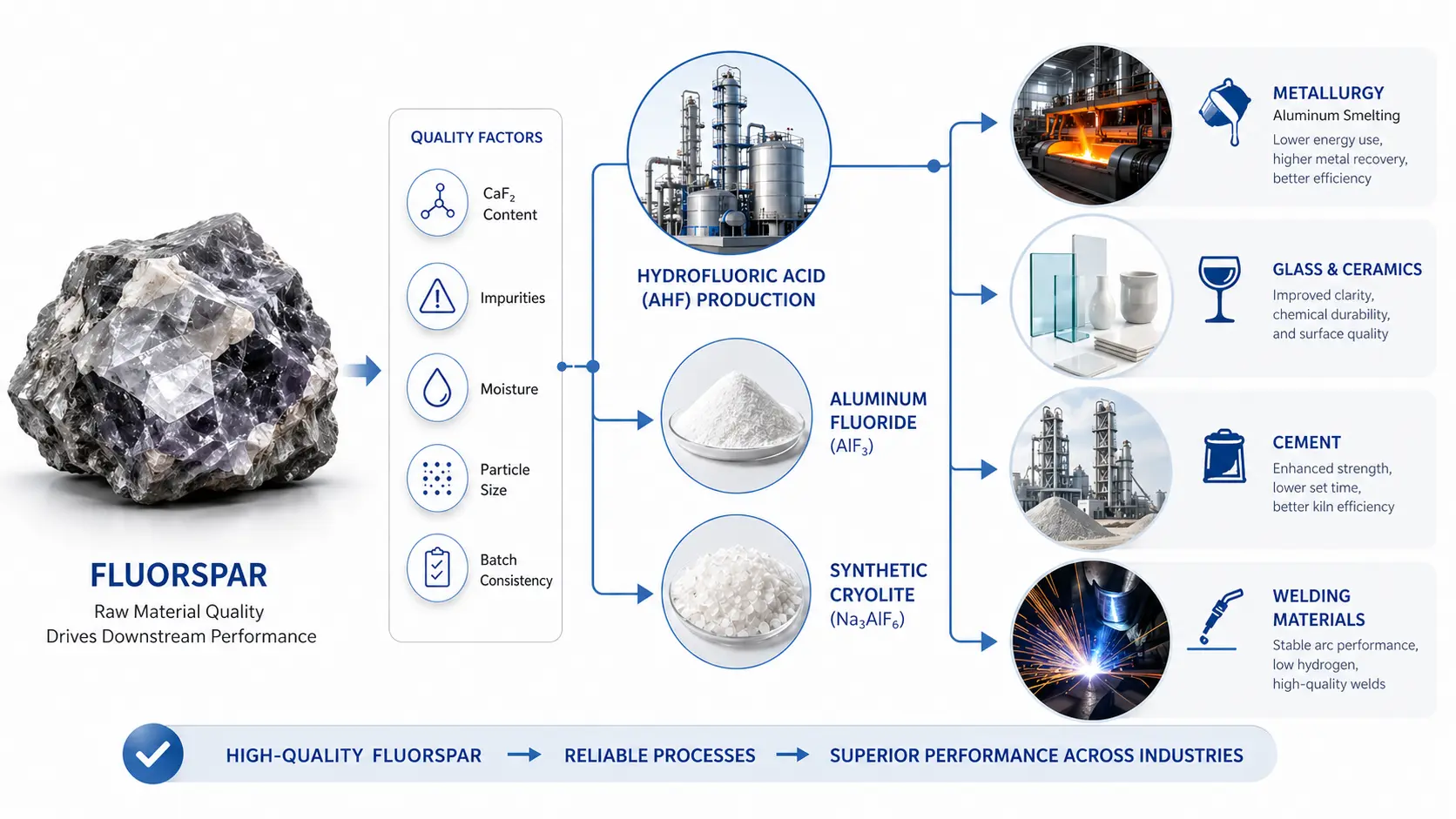
Fluorspar, also known as fluorite, is mainly composed of calcium fluoride (CaF₂). It is an important industrial mineral used in fluorochemical production, metallurgy, aluminum fluoride, synthetic cryolite, glass, ceramics, cement, and welding materials.
For downstream users, fluorspar quality should not be judged only by CaF₂ content. The more important question is whether the full specification matches the actual process requirements.
In real procurement, two batches of fluorspar with similar CaF₂ content may perform differently. Differences in impurities, moisture, particle size, and batch consistency can affect acid reaction efficiency, fluxing behavior, feeding stability, storage performance, and overall process control.
In industrial trade, fluorspar is commonly classified into acid grade and metallurgical grade.
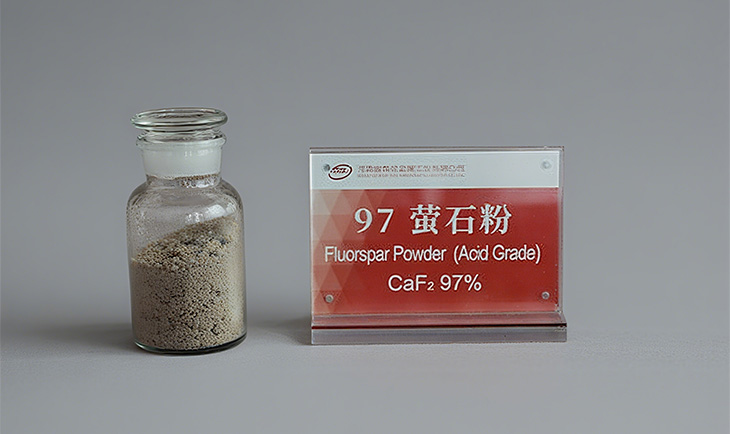
Acid grade fluorspar generally refers to a flotation concentrate with CaF₂ content above 97%, mainly used for hydrofluoric acid production. Fluorspar below acid-grade requirements may be used in metallurgy, ceramics, cement, welding materials, or other industrial applications, depending on its actual specification.
Why CaF₂ Content Alone Cannot Define Fluorspar Quality
CaF₂ Content Defines the Basic Application Range
CaF₂ content is the basic indicator for evaluating fluorspar grade and application direction.
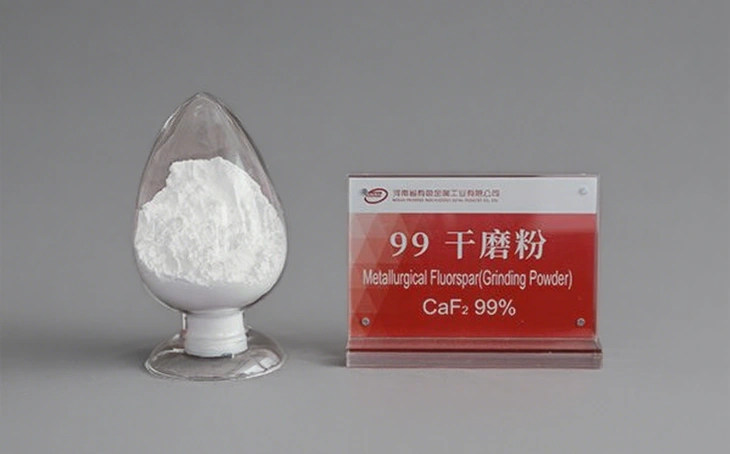
Higher CaF₂ content is generally more suitable for hydrofluoric acid and fluorochemical production. Metallurgical grade fluorspar is more commonly used in steelmaking, casting, cement, ceramics, glass, and welding materials.
However, CaF₂ content only reflects the approximate level of effective calcium fluoride in the material. It cannot fully explain how fluorspar will perform in a production system.
For downstream plants, production stability is often affected by a combination of factors, including:
- impurity composition;
- moisture control;
- particle size distribution;
- batch consistency;
- supply source stability.
Impurities, Moisture, and Particle Size Affect Real Process Performance
After fluorspar enters downstream production, it does not function only as a chemical composition on a specification sheet.
It participates in reaction, melting, conveying, feeding, storage, and process control. This is why impurities, moisture, and particle size can directly influence actual industrial performance.
In fluorochemical production, fluorspar is used as a key fluorine source for hydrofluoric acid production. Hydrofluoric acid, especially anhydrous hydrogen fluoride, is an important basic raw material for many fluorochemicals.
These downstream products may include refrigerants, fluoropolymers, aluminum fluoride, synthetic cryolite, and other fluorine-containing materials.
In metallurgical applications, fluorspar is mainly used as a flux. Its value lies in improving the melting process, enhancing slag fluidity, and helping the metallurgical system maintain more stable slag control.
Therefore, fluorochemical customers usually focus more on purity, impurity control, and batch consistency. Metallurgical customers pay more attention to fluxing efficiency, particle form, fines content, and feeding performance.
Key Quality Factors That Influence Fluorspar Performance
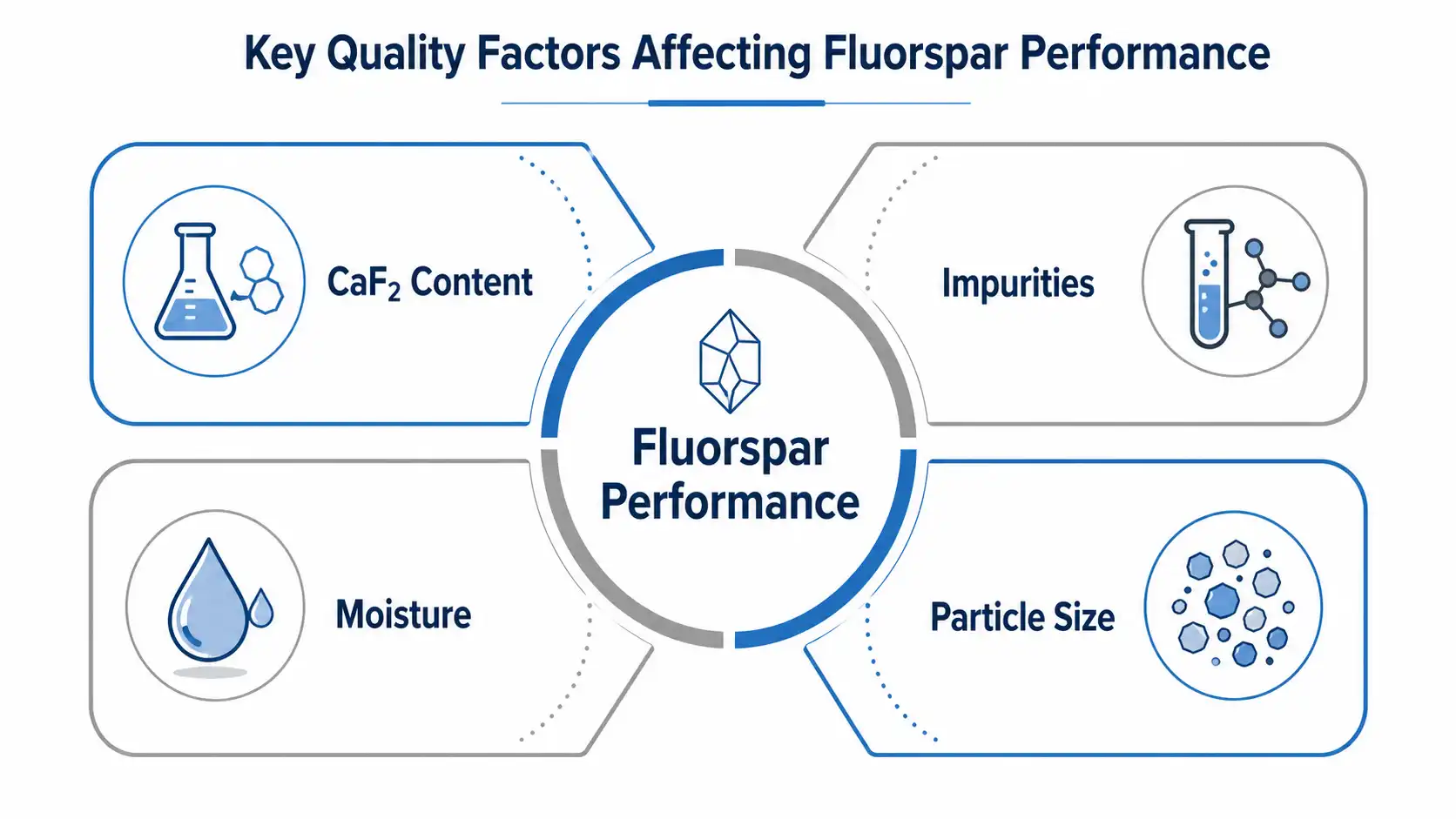
Impurities and Chemical Composition
In addition to CaF₂, common quality indicators in fluorspar procurement include SiO₂, CaCO₃, S, P, Fe₂O₃, Al₂O₃, and other trace impurities.
Different applications have different sensitivity levels to these impurities.
In fluorochemical production, impurity control is usually stricter. Once fluorspar enters the acid reaction system, impurities may affect acid consumption, reaction efficiency, by-product quality, downstream purification load, and equipment stability.
For hydrofluoric acid, aluminum fluoride, synthetic cryolite, and related fluorochemical products, raw material fluctuations may also be transferred to later production stages.
In metallurgical applications, impurity control is more closely related to slag chemistry and smelting operations.
As a fluxing material, fluorspar helps improve melt behavior and slag fluidity. Buyers need to evaluate whether impurities may affect slag composition, smelting cost, or process control.
Impurities should not be evaluated simply as “the lower, the better.” The key is whether they remain within the acceptable range for the target application.
High-end fluorochemical applications usually require stricter impurity control. Some metallurgical, cement, or ceramic applications may have higher tolerance, but stability and controllability are still essential.
Moisture and Storage Stability
Moisture can affect fluorspar storage, transportation, feeding, and process stability.
For powder or concentrate materials, excessive or unstable moisture may cause caking, weighing deviation, conveying problems, and increased drying load.
Moisture should not be understood simply as “the lower, the better.” Different delivery forms and downstream processes have different moisture requirements.
Acid grade fluorspar may sometimes be transported as wet filter cake to improve handling and reduce dust. Before entering hydrofluoric acid production, it is usually dried according to process requirements.
Therefore, buyers should focus on three practical questions:
- whether moisture is stable;
- whether it meets contract specifications;
- whether it fits the storage and feeding system.
For long-term procurement, stable moisture control helps reduce frequent adjustments of feeding, drying, and weighing parameters.
Particle Size and Feeding Behavior
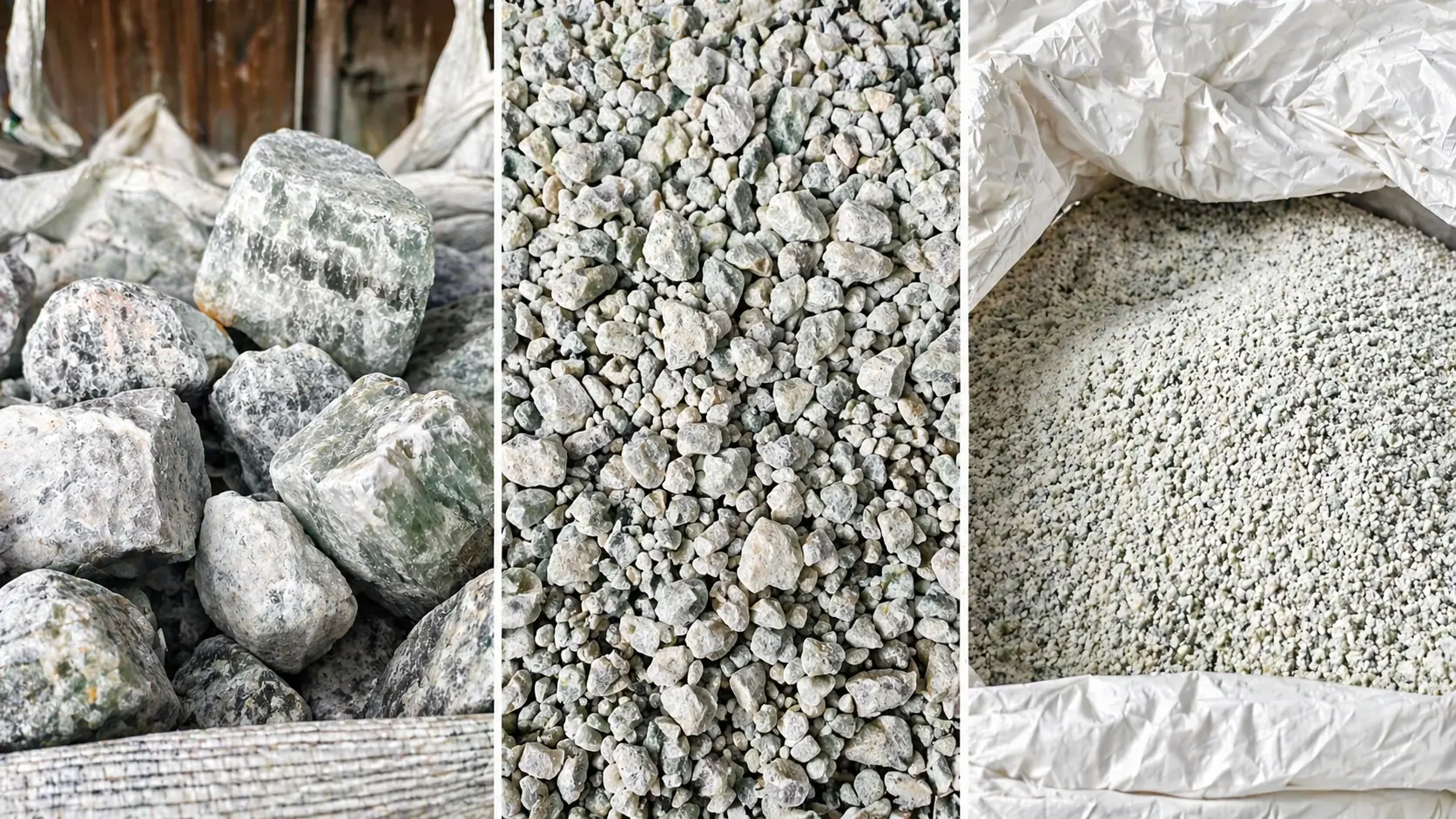
Particle size is an important physical factor affecting fluorspar performance.
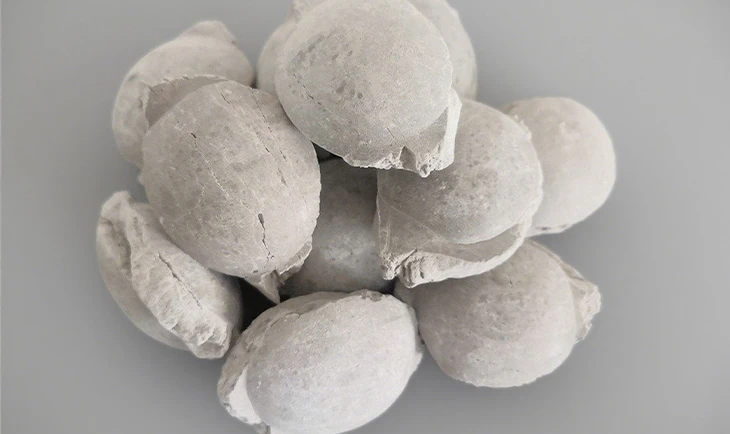
Powdered materials are more suitable for some reaction systems. Lump or granular fluorspar is more common in metallurgical, casting, and fluxing applications.
In fluorochemical production, particle size affects reaction contact efficiency, material conveying, drying behavior, and dust control.
Excessively fine material may increase dust and handling difficulty. Overly coarse particles may affect reaction uniformity or equipment compatibility.
In metallurgical applications, particle size has a direct influence on feeding convenience, melting speed, and operation stability.
Oversized lumps may slow down melting. Excessive fines may increase material loss, dust, and uneven feeding.
Therefore, particle size should be evaluated together with the actual equipment and process. Buyers should confirm whether the supplier’s particle size range fits their feeding system, storage conditions, reaction method, or smelting operation.
How Fluorspar Quality Requirements Differ by Application
Fluorochemical Production Requires Higher Purity and Stability
Fluorochemical production is one of the most important downstream applications of fluorspar.
After processing, fluorspar can be used to produce hydrofluoric acid or anhydrous hydrogen fluoride. These materials then enter the supply chain for refrigerants, fluoropolymers, aluminum fluoride, synthetic cryolite, electronic chemicals, and other fluorine-containing materials.
For fluorochemical customers, fluorspar quality affects not only raw material utilization but also downstream product stability.
In continuous production, raw material fluctuations may increase process adjustment frequency, purification load, and quality control difficulty.
Fluorspar used in fluorochemical production usually requires stronger attention to:
- CaF₂ content;
- control of SiO₂, CaCO₃, S, P, and other impurities;
- moisture and particle size stability;
- consistency across continuous batches;
- ore source traceability, test documents, and quality records.
For downstream customers, one qualified batch does not equal long-term supply stability. Continuous batch consistency is closer to real procurement value.
Metallurgical Applications Focus on Fluxing Efficiency and Slag Behavior
In metallurgy, fluorspar is mainly used as a flux in steelmaking, casting, and certain furnace charge systems.
Its main role is to improve the melting process, enhance slag fluidity, and support stable slag control.
Unlike fluorochemical production, metallurgical applications do not always require acid-grade purity. Instead, they focus more on practical effectiveness and stability during use.
CaF₂ content, lump size, fines content, moisture, and impurities can all affect fluxing performance, feeding loss, and furnace condition control.
Therefore, metallurgical grade fluorspar procurement should not be based on price or CaF₂ content.
Buyers should also consider actual fluxing efficiency, feeding convenience, material loss, and batch stability.
Different Processes Have Different Tolerance for Quality Variation
The same batch of fluorspar may be evaluated differently in different processes.
In a fluorochemical plant, impurity fluctuation may affect the acid reaction system and downstream product quality. In metallurgical use, particle size, lump form, and fluxing efficiency may have a more direct impact on on-site performance.
In cement, glass, ceramics, or welding material applications, the key concerns may be different again.
This means there is no single “best grade” of fluorspar for all applications. The core of procurement evaluation is not to pursue the highest CaF₂ content, but to confirm whether the quality indicators match the final application.
From a supplier perspective, professional value is not only reflected in providing a product specification sheet. It also lies in understanding the customer’s application scenario and helping confirm the suitable grade, particle size, packaging method, and testing requirements.
How Buyers Should Match Fluorspar Quality with the Final Application
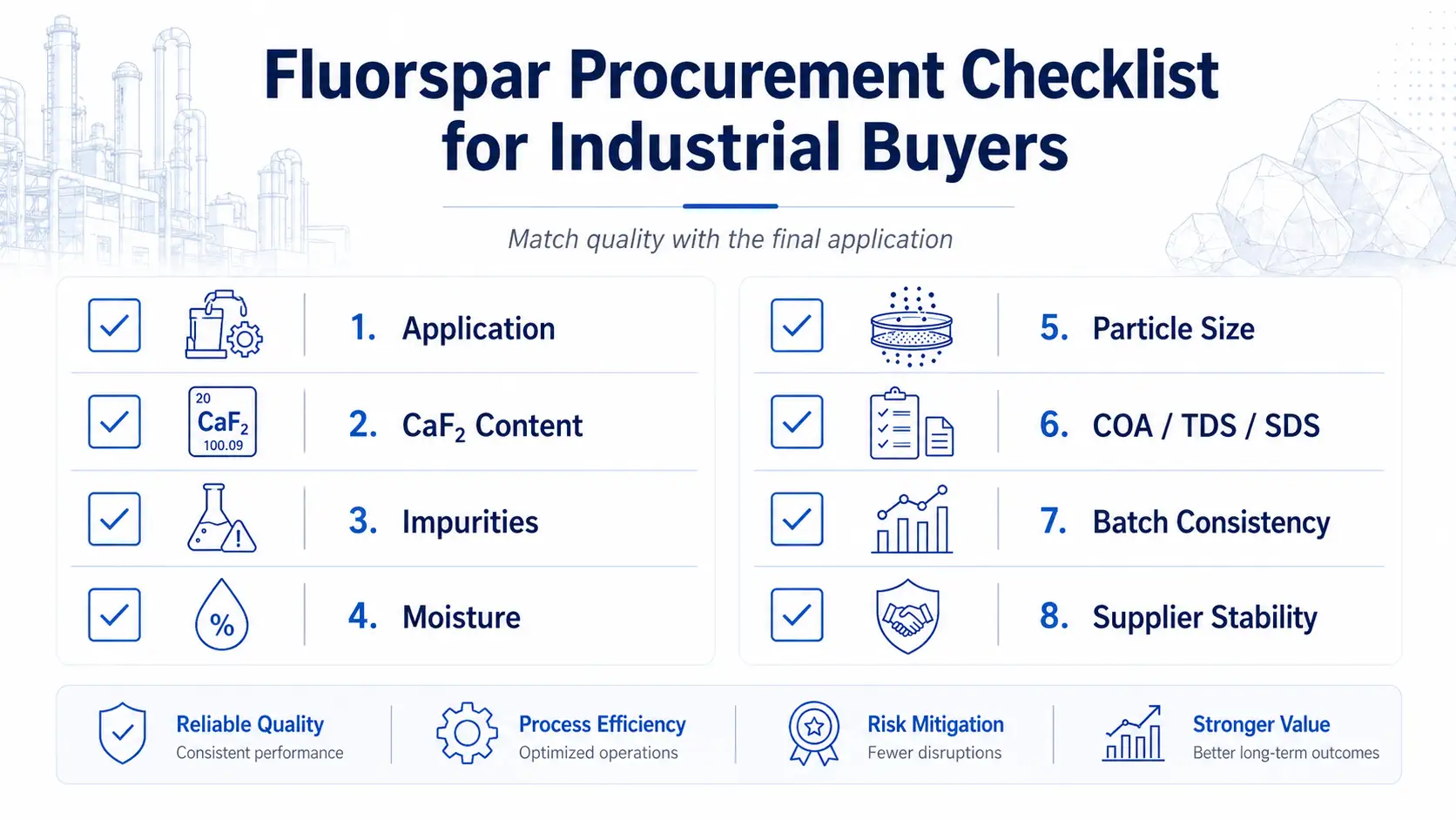
Before purchasing fluorspar, buyers should first clarify the final application and then review the specification.
Fluorochemical customers should focus on CaF₂, SiO₂, CaCO₃, moisture, particle size, impurity limits, batch consistency, and quality documents.
Metallurgical customers should focus on effective CaF₂ content, lump or particle size range, fines content, moisture, fluxing effect, and feeding system compatibility.
COA, TDS, SDS, and sample testing are basic documents, but they cannot replace long-term batch verification.
A more reliable evaluation should combine:
- sample testing;
- trial feedback;
- continuous batch test data;
- packaging and transportation conditions;
- The supplier’s long-term delivery capability.
For long-term procurement, buyers should confirm:
- the fluorspar grade and specification range required by the target application;
- batch stability of key indicators such as CaF₂, SiO₂, CaCO₃, and moisture;
- particle size range, fines content, and feeding system compatibility;
- completeness of COA, TDS, SDS, and batch traceability documents;
- packaging, transportation, and long-term supply stability;
- whether the supplier can provide application communication and continuous delivery support.
Price is part of procurement decision-making, but it should not be the only standard.
For industrial customers, low-cost raw material may increase reaction fluctuation, feeding loss, drying load, slag adjustment, or even production interruption. The final cost may be higher than the savings made during purchasing.
The key to fluorspar procurement is to select a material that matches the actual process, maintains controllable quality variation, and supports stable supply.
Conclusion: Fluorspar Quality Should Be Evaluated by Application Fit
CaF₂ content defines the basic application range of fluorspar, but it cannot define fluorspar quality alone.
Impurity composition, moisture, particle size, batch consistency, and supply stability determine how fluorspar performs in downstream industrial processes.
In fluorochemical production, fluorspar quality affects the stability of hydrofluoric acid, aluminum fluoride, synthetic cryolite, and other fluorine-containing material supply chains.
In metallurgical applications, fluorspar quality affects fluxing efficiency, slag behavior, and feeding performance.
For industrial buyers, suitable fluorspar is not simply the material with the highest content or the lowest price. It is the raw material that can consistently meet downstream production requirements.
Evaluating specifications by application, verifying batch stability, and confirming supplier delivery capability are key to reducing procurement risk and maintaining production continuity.
FAQ
Is fluorspar quality determined only by CaF₂ content?
No. CaF₂ content is the basic indicator for evaluating fluorspar grade and application direction, but it cannot fully define actual performance.
Impurities, moisture, particle size, batch consistency, and supply stability also affect fluorspar behavior in downstream processes.
What is the main difference between acid grade and metallurgical grade fluorspar?
Acid grade fluorspar usually has higher CaF₂ content and is mainly used for hydrofluoric acid and fluorochemical production.
Metallurgical grade fluorspar is more commonly used in steelmaking, casting, and fluxing applications, where fluxing efficiency, particle form, fines content, and on-site handling stability are important.
Why can fluorspar with similar CaF₂ content perform differently?
Because CaF₂ content is the only main component indicator.
Even if two fluorspar batches have similar CaF₂ levels, differences in SiO₂, CaCO₃, moisture, particle size distribution, or batch consistency can lead to different performance in acid reaction, metallurgical fluxing, conveying, feeding, and storage.
What should fluorochemical buyers check when purchasing fluorspar?
Fluorochemical buyers should review CaF₂ content, SiO₂, CaCO₃, S, P, moisture, particle size, batch consistency, and quality traceability documents such as COA, TDS, and SDS.
It should also include an assessment of whether the supplier can provide consistent batches and long-term delivery support.