Sodium fluoride (NaF) should not be selected under a single standard across industrial systems.
In industrial chemical applications, it is typically treated as a fluorine-containing inorganic raw material or a functional salt in process formulations. In glass-related applications, it is more often used in specific formulation systems, including certain opal glass, glazes, frits, enamels, and other fluorine-containing mixtures, rather than as a universal raw material for all glass manufacturing scenarios.
For this reason, the key to sodium fluoride selection is not whether “higher specifications are always better,” but whether the grade matches the actual process window, impurity tolerance, feeding method, storage conditions, and safety management requirements. For procurement teams and process engineers, the real objective is consistency in application performance, not just individual numbers on a certificate of analysis.
Why These Applications Require Different Sodium Fluoride Selection Logic
Process Priorities in Industrial Chemical Applications
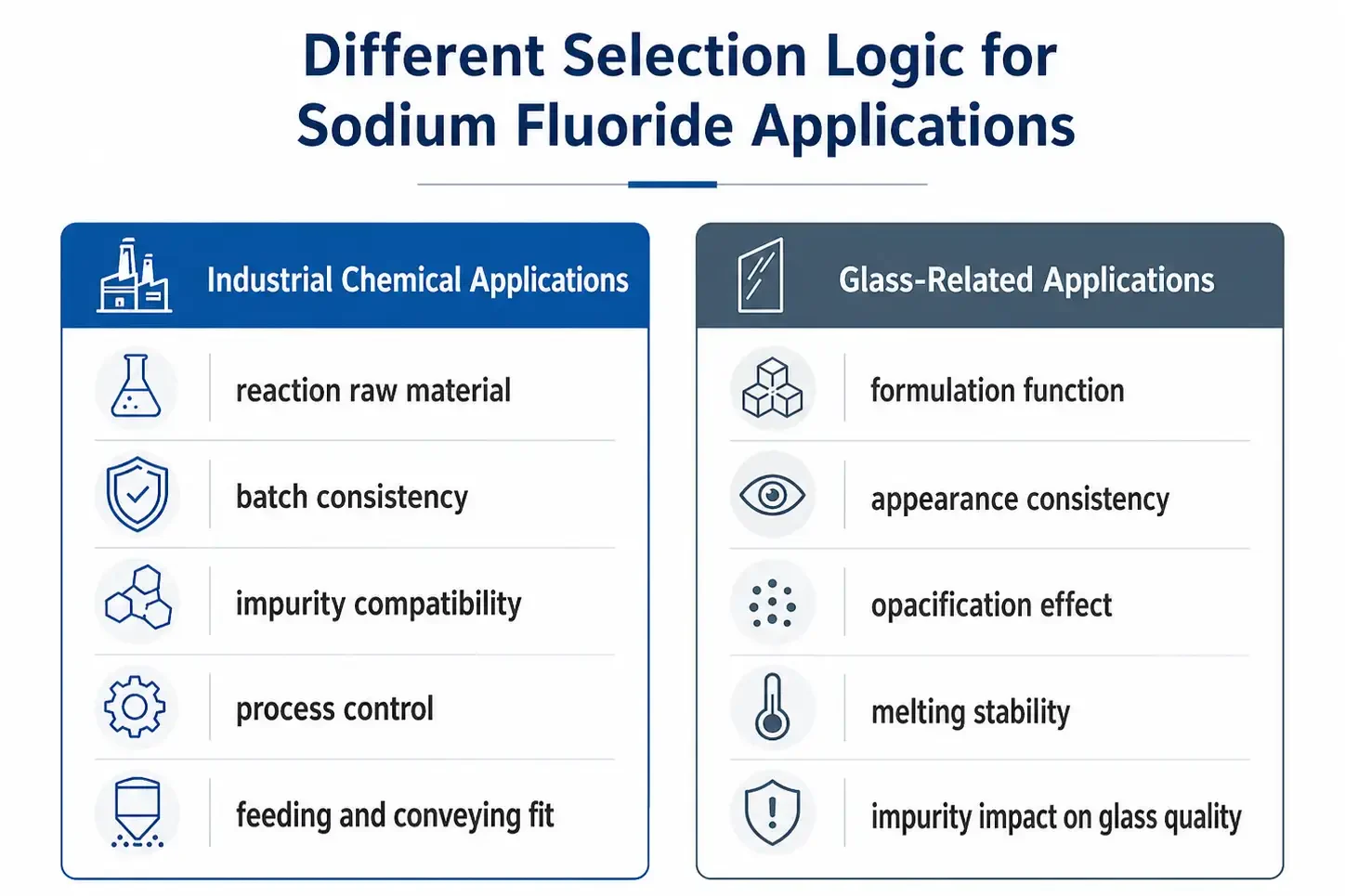
In industrial chemical applications, sodium fluoride functions more as a reaction raw material or an inorganic functional salt. In this type of use, the following factors usually require closer attention:
- Whether the main content is stable enough to support continuous or batch production.
- Whether moisture, insoluble matter, and soluble impurities may affect reaction efficiency, filtration behavior, or downstream treatment;
- Whether impurity ions and trace metals may introduce side reactions, corrosion risks, or purity fluctuations;
- Whether particle size distribution, flowability, and caking tendency fit the existing feeding and conveying system.
In chemical systems, sodium fluoride should first be understood as a process control variable. Even when the material is classified as industrial-grade sodium fluoride, batch-to-batch variation in moisture, impurity profile, or particle size distribution may not immediately appear as “unusable material.” More often, it appears as a narrower process window, longer filtration time, yield fluctuation, or increased cleaning frequency.
Therefore, in industrial chemical applications, selection should focus on batch consistency and process compatibility, rather than relying only on whether a single batch meets standard specifications.
Process Priorities in Glass-Related Applications
The selection logic is different in glass-related applications. In these cases, sodium fluoride should not simply be viewed as a common inorganic salt, but as a functional component in a specific formulation. It may contribute to opacification, fluxing behavior, melt regulation, or certain appearance effects, but these functions are always dependent on the formulation design and actual process conditions.
One point should be made clear:
Sodium fluoride is not suitable for all glass systems, and there is no universal rule that the glass industry generally prioritizes sodium fluoride.
In glass-related applications, procurement and technical teams should pay closer attention to:
- How fluorine introduction affects opacification, appearance consistency, and surface quality;
- Whether impurities may cause color deviation, bubbles, streaks, abnormal crystallization, or melting instability;
- Whether powder particle size is compatible with batching uniformity, mixing efficiency, and dust control;
- Whether the current formulation truly requires sodium fluoride, or whether another fluorine-containing raw material would be more suitable.
Accordingly, the core issue in glass-related selection is not simply whether the material “can be used,” but whether the grade matches the target appearance and melting conditions. This is also the fundamental difference between glass-related applications and industrial chemical applications in sodium fluoride selection.
The Most Important Specification Factors in Each Application
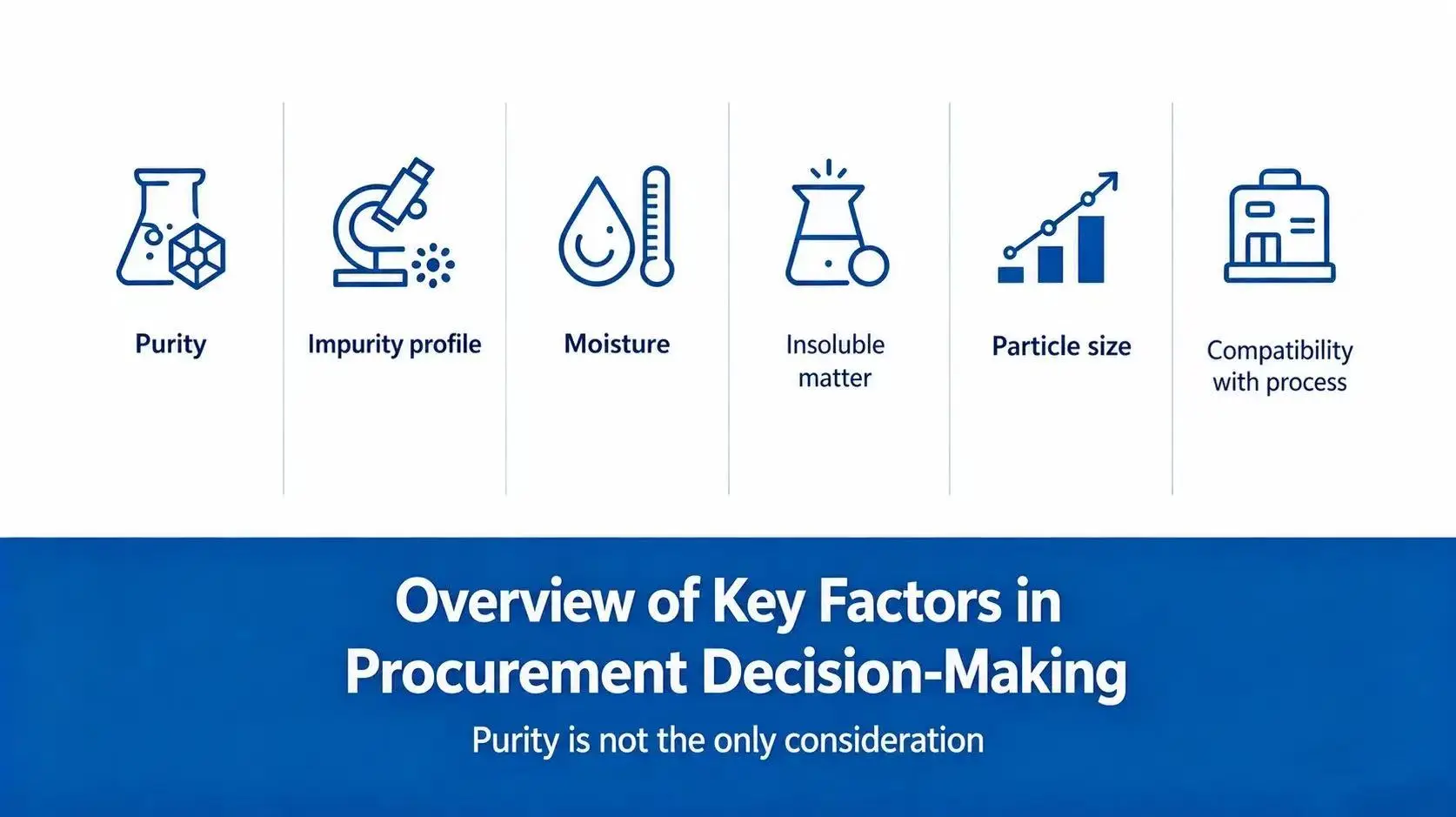
Purity and Compatibility Considerations
Purity is a basic parameter, but in industrial procurement, it should not be evaluated in isolation.
A more practical question is: Does the impurity structure in this specification match the real risk points of the current process?
In industrial chemical applications, the key concerns are usually:
- Whether the main content meets metering and reaction balance requirements;
- Whether moisture affects storage stability, weighing accuracy, or downstream process performance;
- Whether insoluble matter increases filtration load or reduces system cleanliness;
- Whether soluble impurities, acid or alkali residues, and metal contaminants affect equipment, reaction behavior, or final product quality.
In glass-related applications, the focus is more likely to shift to:
- Whether impurities alter color, transparency, or opacification performance;
- Whether impurity fluctuation causes surface defects, streaks, bubbles, or unstable appearance;
- Whether the same grade performs consistently under different furnace conditions and formulation systems.
For this reason, procurement should not stop at asking, “What is the purity level?” It should go further and confirm:
Which impurities are controlled, to what level, and whether that control corresponds to the actual process risk.
Physical Form and Process Fit
The physical form of sodium fluoride directly affects feeding efficiency, shopfloor cleanliness, dust load, and operational stability.
In many cases, selection errors are caused less by the chemical composition itself than by a mismatch between physical form and the actual production system.
In general:
- Fine powder grades are more favorable for dispersion and dissolution, but they create higher dust-control pressure.
- Coarser particles or higher bulk-density grades are often more suitable for conveying, metering, and cleaner handling, but dissolution rate and mixing uniformity must be evaluated.
- Automatic feeding systems usually place greater importance on particle size distribution, flowability, and caking risk.
- Manual bag opening or intermittent feeding operations often place greater importance on packaging integrity, moisture resistance, and dust suppression.
In glass-related formulations, physical form can also affect mixing uniformity and local concentration distribution. In industrial chemical systems, it more directly influences feeding rhythm, dissolution time, and batch repeatability.
Therefore, particle size and physical form are not secondary details. They are process-fit parameters.
How Buyers Can Reduce Selection Errors
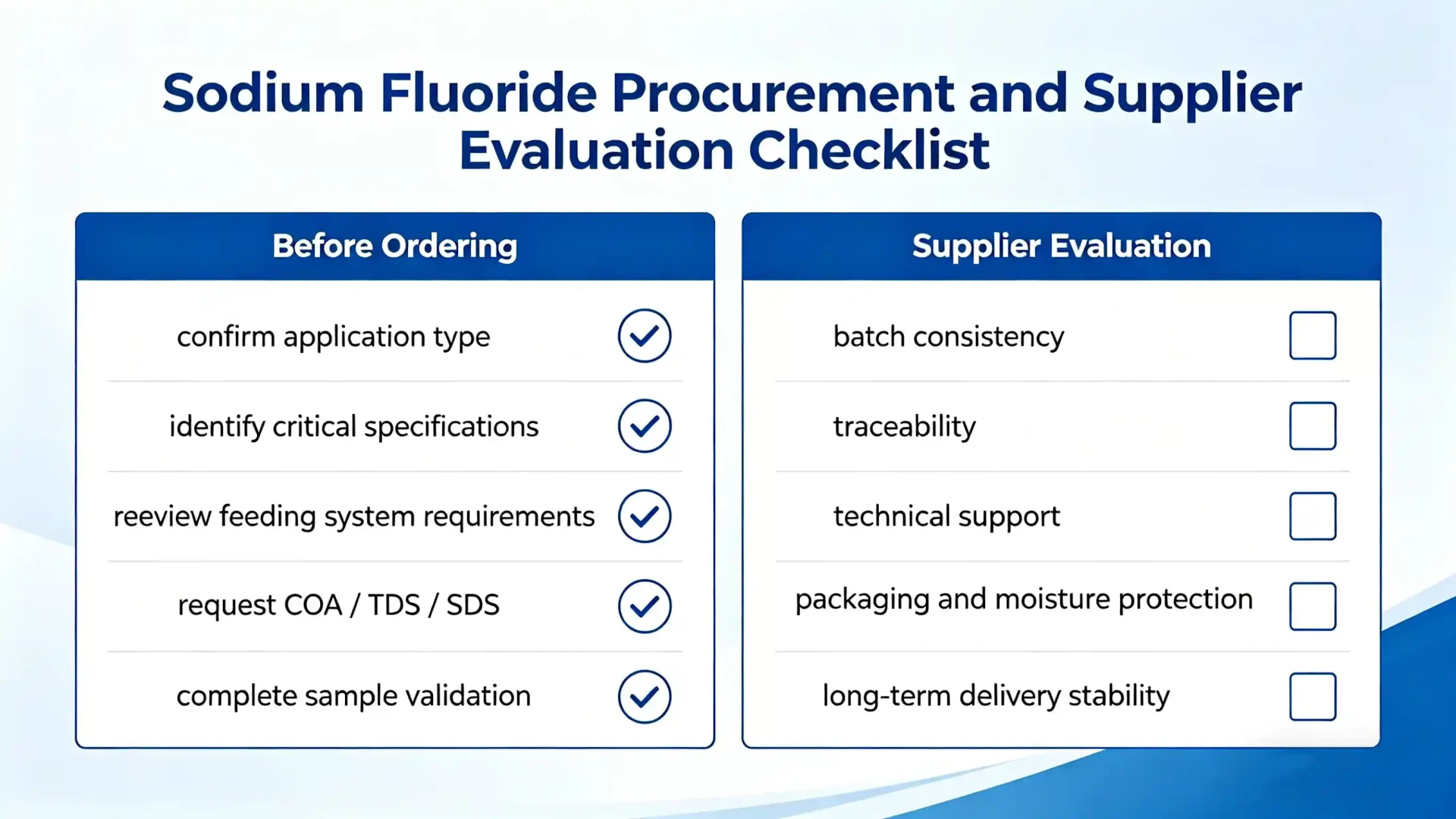
Practical Questions Before Ordering
Before placing an order, the following points should be confirmed first:
- Whether the current use belongs to an industrial chemical reaction system or a glass-related formulation system;
- Which parameter is most sensitive in the current process: main content, moisture, insoluble matter, particle size, or a specific impurity?
- What type of feeding method is used on site, and how much tolerance does the current system have for powder, particles, flowability, and caking?
- Whether the supplier should provide recent-batch COA, TDS, SDS, particle size data, and typical application information;
- Whether sample validation or lab-scale testing has already been completed under the actual process conditions.
Two common mistakes should be avoided at this stage.
The first is placing orders only on the basis of general industry specifications while overlooking the most sensitive variables of the actual process.
The second is replacing compatibility assessment with price comparison, which often leads to higher correction costs later in production.
In addition, sodium fluoride is a fluorine-containing industrial chemical that requires disciplined handling. Selection should not focus only on whether the material is usable. It should also assess the safety management requirements associated with storage, bag opening, feeding, and waste handling. For industrial users, this is not an extra consideration. It is part of the procurement decision itself.
Supplier Checks for Long-Term Cooperation
Long-term cooperation should not be evaluated only by whether the supplier can maintain shipments. It should be assessed by whether the supplier can consistently deliver a usable specification over time. The following points are worth checking:
- Whether the specification remains consistent over the long term, rather than performing well only in the first sample batch.
- Whether the supplier has batch traceability, retained-sample management, and corrective action mechanisms;
- Whether the supplier can provide technical documentation aligned with actual application needs, instead of only a generic data sheet;
- Whether the supplier understands the difference in selection logic between industrial chemical and glass-related applications.
- Whether the supplier can maintain stable packaging quality, moisture protection, and transport execution.
For buyers, the real way to reduce selection errors is not single-order price compression, but establishing a supplier evaluation standard built around batch consistency, process compatibility, and problem-response capability.
In industrial systems, the ability to deliver the same result consistently is often more valuable than a lower one-time price.
Conclusion
The selection logic for sodium fluoride is not the same in industrial chemical applications and glass-related applications.
The former places greater emphasis on reaction consistency, impurity compatibility, and process control. The latter places greater emphasis on formulation fit, appearance-related risk, and melting stability. Effective procurement judgment does not treat sodium fluoride as a standardized commodity only. It treats it as a functional raw material tied to a specific process window.
For this reason, selection should be evaluated across four dimensions:
- Whether the application category has been correctly defined;
- Whether the specification and impurity profile match the process risk.
- Whether the physical form fits the on-site system;
- Whether the supplier has the capability for long-term, stable delivery.
Only when all four conditions are met does a “qualified” sodium fluoride grade become genuinely usable in industrial practice.
CTA
Looking for a sodium fluoride grade that fits your process?
Tell us your application, required specifications, and operating conditions. We can help you review purity, impurity profile, particle size, and supply consistency before ordering.