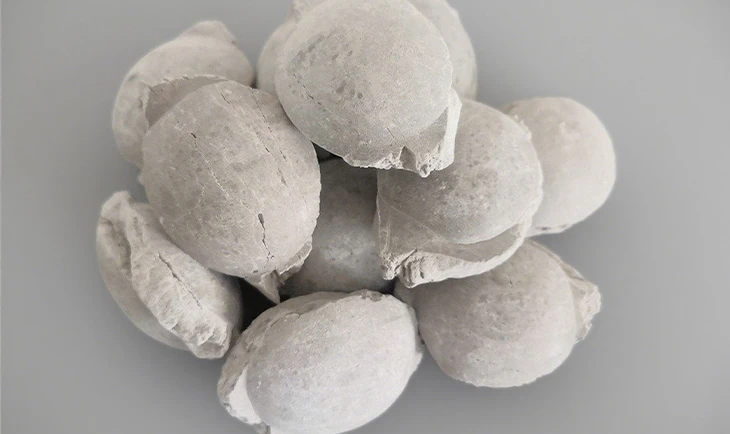
Fluorspar, also known as fluorite, is an industrial mineral feedstock mainly composed of calcium fluoride, CaF₂. For the fluorochemical and aluminum smelting industries, its value lies not only in the mineral itself, but also in its role as an upstream source of fluorine for industrial supply chains.
In aluminum smelting-related supply chains, fluorspar is usually not the primary raw material directly added to electrolytic cells. However, it is closely connected with key fluoride materials such as hydrofluoric acid, anhydrous hydrogen fluoride, aluminum fluoride, and synthetic cryolite.
According to USGS data, CaF₂ is used in the production of anhydrous hydrogen fluoride. Hydrofluoric acid is also an important feedstock for many fluorine-bearing chemicals and is linked with chemicals used in primary aluminum processing.
For large aluminum smelters, the importance of fluorspar should not be understood only as basic mineral knowledge. It should be evaluated as part of the upstream resource base that may affect the supply stability, cost fluctuations, batch consistency, and long-term delivery capability of aluminum fluoride, synthetic cryolite, and other fluoride materials used in aluminum smelting.
What Is Fluorspar as an Industrial Mineral?

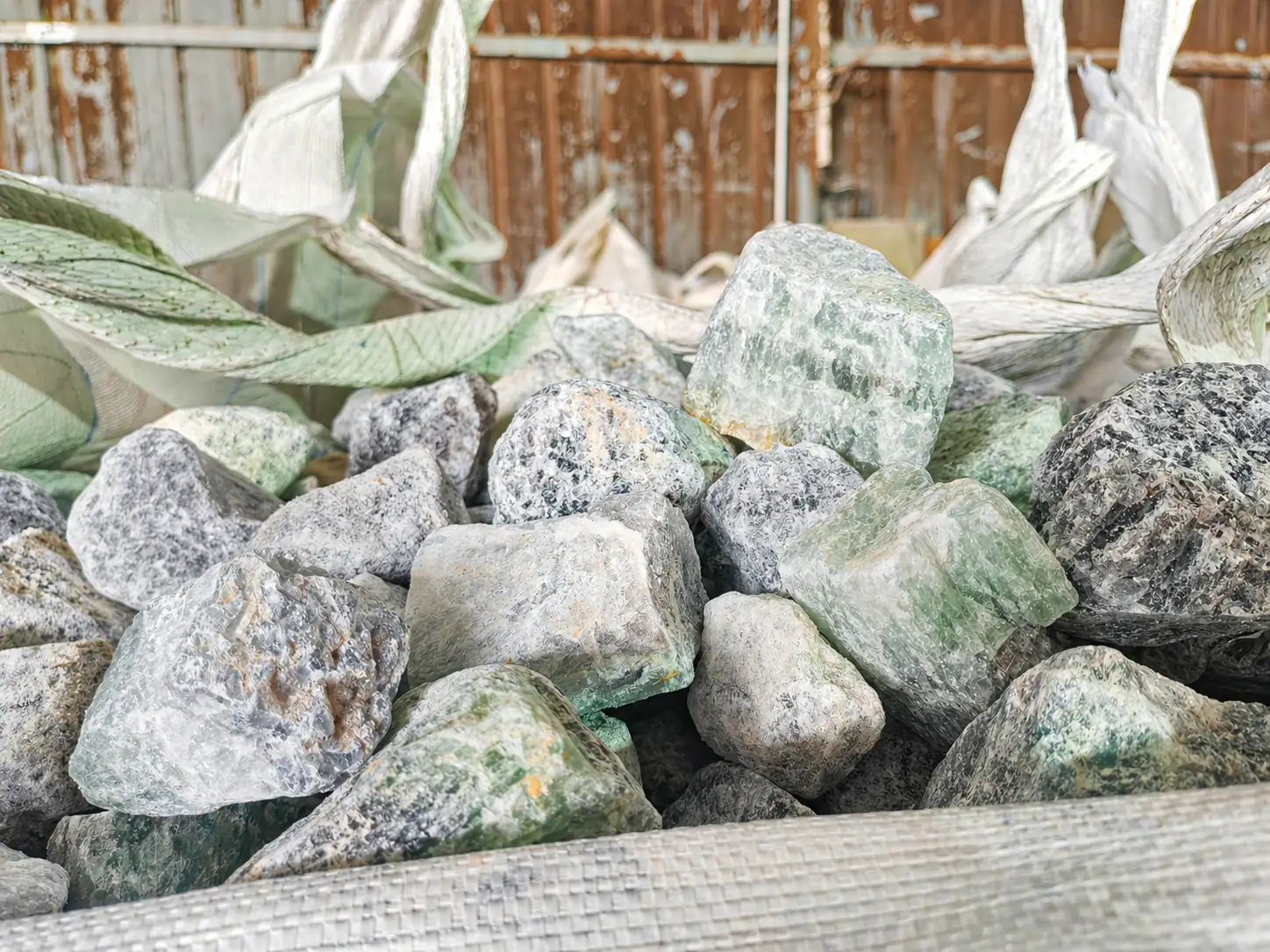
A Calcium Fluoride-Based Source of Fluorine
From an industrial perspective, fluorspar is best understood as an upstream source of fluorine for chemical and metallurgical production. Its key evaluation criteria are not color, crystal form, or ornamental value, but whether it can consistently meet downstream production requirements.
In practical procurement and application, fluorspar is commonly evaluated based on the following factors:
- CaF₂ content
- SiO₂, CaCO₃, and other impurity levels
- Moisture
- Particle size distribution
- Batch consistency
- Packaging and transportation conditions
- Quality documents and testing records
Among these factors, CaF₂ content is a fundamental indicator, but it is not the only basis for evaluation. For different downstream applications, impurity type, particle size stability, and moisture control can also affect production efficiency, reaction conditions, and product consistency.
For fluorochemical producers, fluorspar is an important raw material foundation for producing hydrofluoric acid and anhydrous hydrogen fluoride. For large aluminum smelters, it is more accurately understood as an upstream supporting factor behind aluminum fluoride, synthetic cryolite, and other fluoride materials used in aluminum smelting.
Basic Differences Between Acid-Grade and Metallurgical-Grade Fluorspar
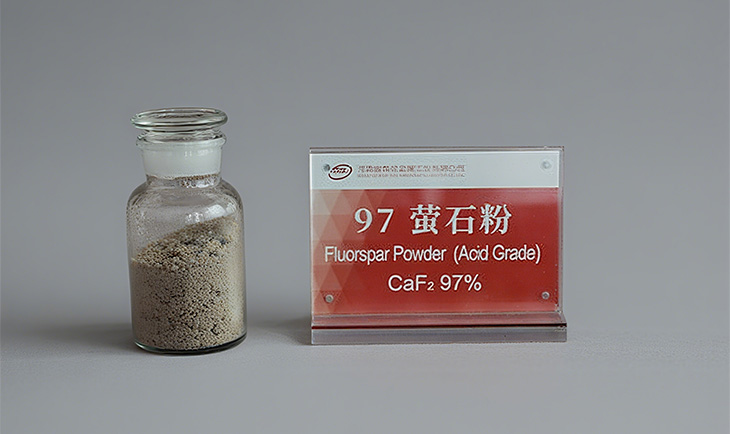
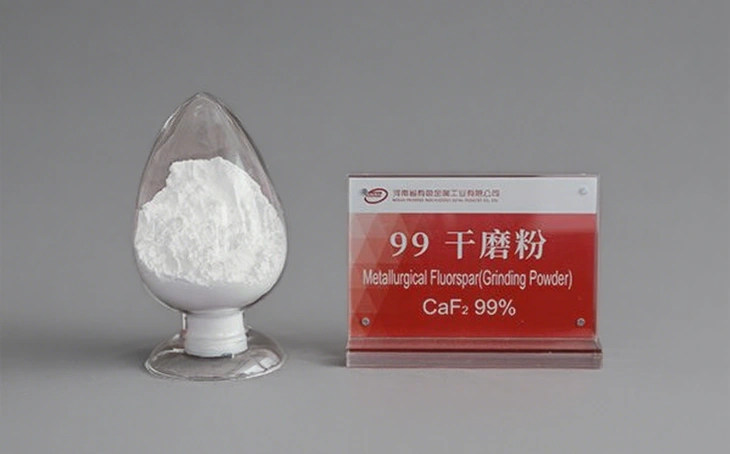
Industrial fluorspar is commonly classified by application and grade into acid-grade fluorspar and metallurgical-grade fluorspar.
In USGS trade classifications, acid-grade fluorspar is listed as containing more than 97% CaF₂, while metallurgical-grade fluorspar is listed as 97% CaF₂ or less. In actual procurement, specifications should still be confirmed according to the contract, application requirements, and supplier technical documents.
This classification should not be understood simply as “acid grade is better” or “metallurgical grade is lower-end.” The correct evaluation logic is whether the fluorspar grade matches the specific downstream process.
Acid-grade fluorspar is more suitable for hydrofluoric acid, anhydrous hydrogen fluoride, and downstream fluorochemical production. It usually requires stricter control of CaF₂ content, SiO₂, moisture, and other impurities.
Metallurgical-grade fluorspar is more commonly used in steelmaking, foundry, cement, glass, welding electrode coatings, and similar applications. Its value is usually related to fluxing performance, particle size compatibility, furnace condition stability, and unit usage cost.
For large aluminum smelter customers, the key concern is often not which grade of fluorspar they directly purchase, but whether their fluoride material supplier has stable upstream fluorine resource support.
How Fluorspar Enters the Fluorochemical Supply Chain
From Fluorspar to Hydrofluoric Acid and Anhydrous Hydrogen Fluoride
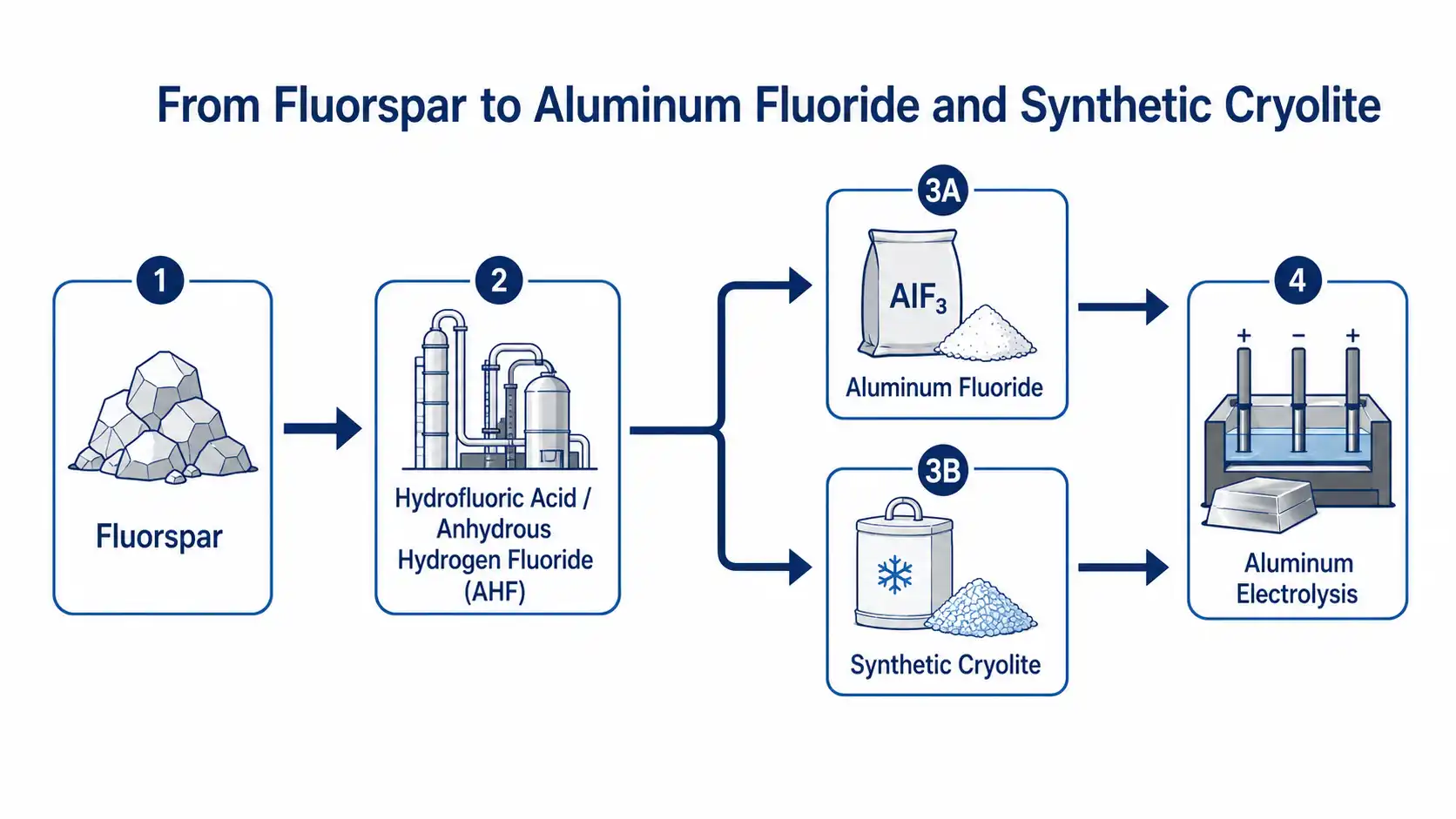
One important route for fluorspar to enter the fluorochemical supply chain is through its reaction with sulfuric acid to produce hydrogen fluoride. The reaction is commonly expressed as:
CaF₂ + H₂SO₄ → CaSO₄ + 2HF
This reaction explains the fundamental position of acid-grade fluorspar in the fluorochemical industry chain. The grade, impurity level, moisture, and particle size of fluorspar may affect reaction efficiency, acid consumption, residue treatment, and the stability of downstream products during hydrofluoric acid production.
For downstream producers, fluorspar is not an isolated mineral purchase. It is the front-end input for hydrofluoric acid, anhydrous hydrogen fluoride, and broader fluorochemical material production.
The more stable the upstream raw material quality, the easier it is to maintain batch control and supply planning for downstream fluorochemical products.
From Hydrofluoric Acid to Aluminum Fluoride, Synthetic Cryolite, and Fluorinated Materials
In the fluorochemical supply chain, hydrofluoric acid and anhydrous hydrogen fluoride are important intermediate links connecting fluorspar with downstream fluorinated materials.
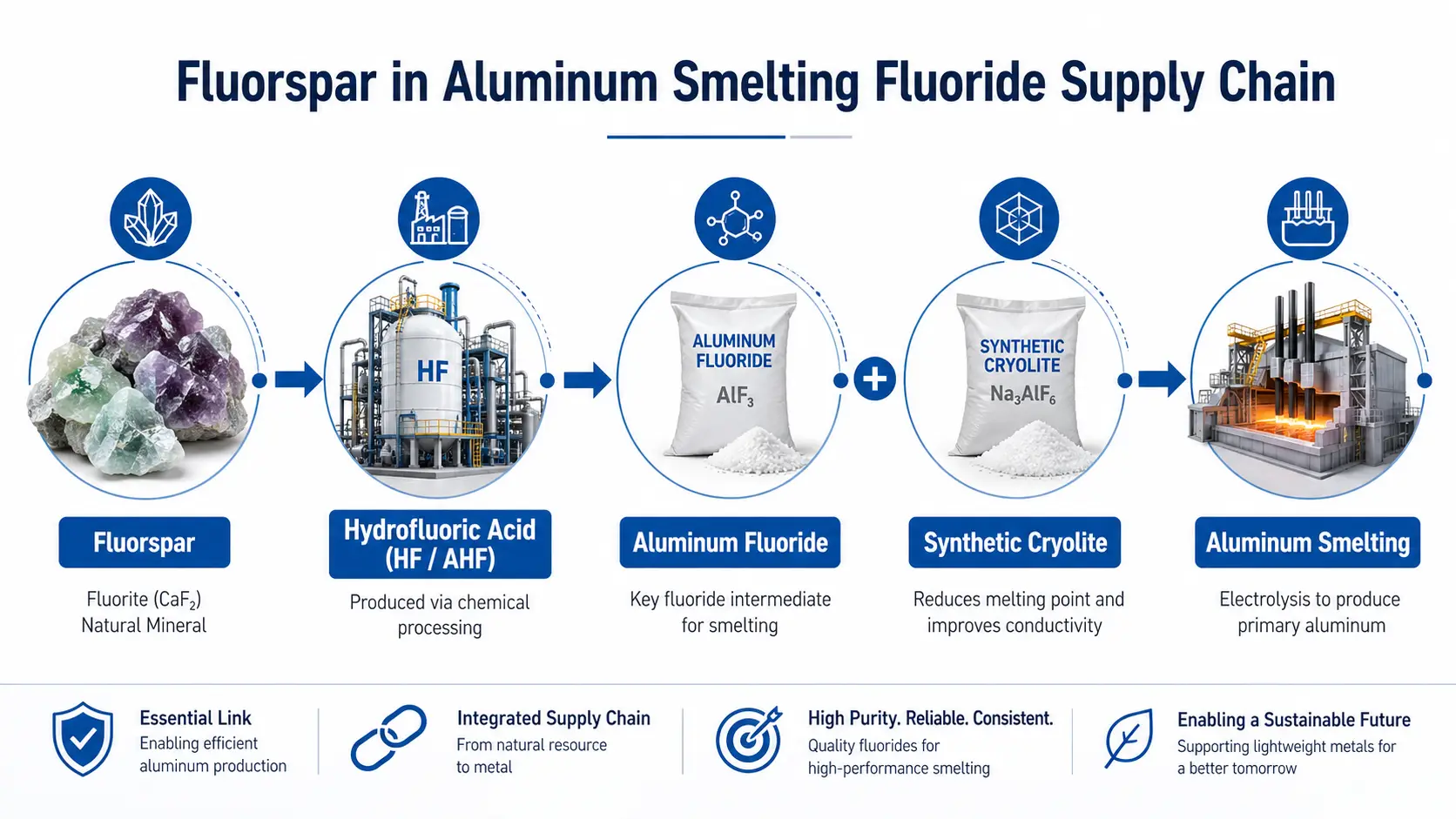
The supply chain can be summarized as:
Fluorspar → Hydrofluoric Acid / Anhydrous Hydrogen Fluoride → Aluminum Fluoride / Synthetic Cryolite / Other Fluorinated Materials → Aluminum Electrolysis and Downstream Industrial Applications
For customers related to aluminum electrolysis, the most important point is the supply chain relationship between fluorspar, aluminum fluoride, and synthetic cryolite.
USGS fluorspar data also tracks related fluorine products such as hydrogen fluoride, aluminum fluoride, and sodium hexafluoroaluminate, which is commonly associated with synthetic cryolite. This reflects the industrial connection between fluorspar and downstream fluorinated materials.
Aluminum fluoride is commonly used electrolyte composition control for aluminum electrolysis, while synthetic cryolite is closely related to the molten salt system used in aluminum smelting.
Although large aluminum smelters usually purchase end-use fluoride materials such as aluminum fluoride and cryolite, the long-term stable supply of these products depends on upstream fluorine resources, hydrofluoric acid supply, and production control systems.
Why Large Aluminum Smelters Should Care About Upstream Fluorspar Stability
Fluorspar Can Affect Aluminum Fluoride Supply Stability
Aluminum fluoride is not an ordinary consumable. It is an important material that affects electrolyte composition and operational stability in aluminum electrolysis systems.
The supply stability of aluminum fluoride depends not only on the producer’s own production capacity, but also on upstream fluorine resources, hydrofluoric acid supply, energy costs, and logistics arrangements.
Fluorspar market supply, grade stability, and price movement may continue to transmit through the hydrofluoric acid and aluminum fluoride production chain.
Global fluorite output reached approximately 10 million metric tons in 2025. Meanwhile, China’s fluorite supply is affected by mine regulation and safety inspections, bringing certain uncertainties to the supply chain.
When evaluating aluminum fluoride suppliers, they should not rely only on short-term pricing or single-batch test results. They should also assess whether the supplier has long-term raw material security, production planning and execution capability, and reliable delivery performance.
Fluorspar Is Linked to Synthetic Cryolite and Smelting Fluoride Supply Chains
Synthetic cryolite is closely related to the aluminum electrolysis system. Its quality stability usually depends on chemical composition, molecular ratio, impurity level, physical form, and batch consistency.
For continuous aluminum smelting operations, whether a supplier can maintain stable specifications over the long term is more important than a single batch of qualified parameters.
Fluorspar is not the only direct evaluation factor for synthetic cryolite. However, as an upstream fluorine resource, it may indirectly affect the supply stability of fluorochemical intermediates and fluoride materials used in aluminum electrolysis.
If upstream fluorine resources become tight, the following areas may be affected:
- Delivery schedules of fluoride materials
- Long-term order execution rhythm
- Procurement cost expectations
- Supplier inventory and production scheduling
- Continuous supply capability for large-volume orders
Therefore, when large aluminum smelters evaluate synthetic cryolite, aluminum fluoride, and related products, they should include the supplier’s upstream resource security in their overall assessment, instead of comparing only listed specifications or one-time test results.
Upstream Raw Material Fluctuations May Increase Procurement and Delivery Risks
Aluminum electrolysis is a continuous production process and requires a stable raw material supply. If fluoride materials experience delivery delays, batch fluctuations, or supply uncertainty, procurement teams may face additional inventory pressure, supplier switching costs, and production planning adjustments.
Upstream fluorspar fluctuations usually do not independently determine the procurement outcome for aluminum smelters. However, they can become part of the supply chain risk assessment for fluoride materials.
This is especially important in long-term orders, large-volume delivery, and cross-border procurement scenarios. Buyers need to determine whether a supplier has continuous supply capability, not only short-term quotation ability.
For large aluminum smelters, reliable suppliers should have three basic capabilities:
- Stable upstream raw material sources
- Controllable production and quality management systems
- Delivery and documentation support suitable for long-term cooperation
How Buyers Should Evaluate Upstream Supply Capability When Purchasing Fluoride Materials
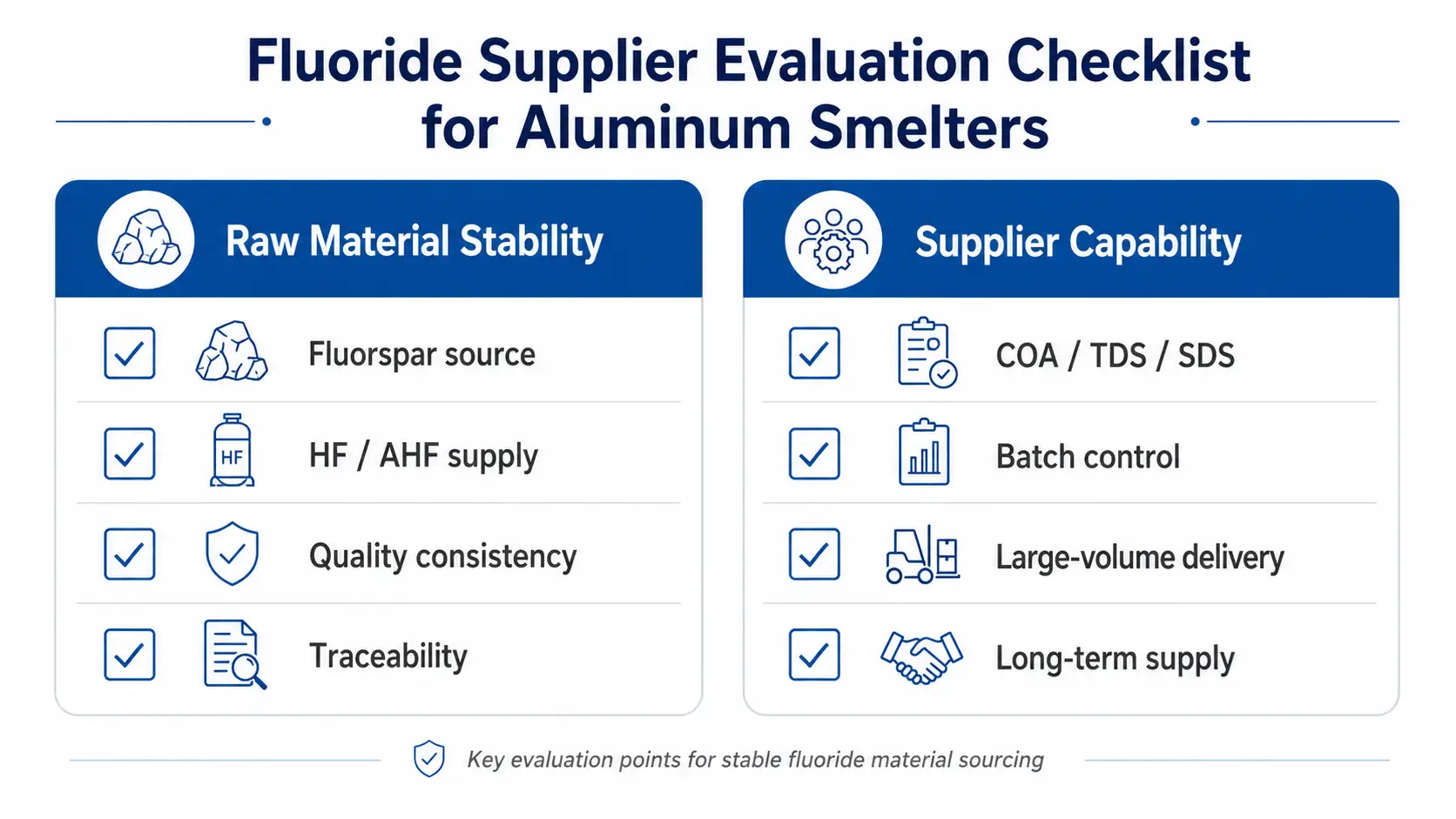
Look Beyond Product Pricing and Assess Supply Chain Control
When large aluminum smelters purchase aluminum fluoride, synthetic cryolite, and other fluoride materials, price is only one evaluation factor. More importantly, the supplier must be able to provide stable, traceable, and verifiable products over the long term.
Buyers may focus on the following questions:
- Does the supplier have stable fluorine resources or raw material supply channels?
- Does the supplier have continuous supply capability for aluminum fluoride, synthetic cryolite, and related products?
- Can the supplier provide basic quality documents such as COA, TDS, and SDS?
- Does the supplier have batch testing and traceability capability?
- Can the supplier support large-volume orders and long-term delivery plans?
- Does the supplier have experience in export packaging, warehousing, shipment, and logistics coordination?
- Can the supplier organize stable production schedules according to the aluminum smelter’s procurement cycle?
Batch Consistency and Long-Term Supply Capability Matter More for Large Smelters
Aluminum electrolysis systems are sensitive to. If aluminum fluoride, synthetic cryolite, and related products show significant batch fluctuations, technical teams may face greater adjustment pressure, and procurement teams may lose confidence in long-term supplier cooperation.
Large aluminum smelter procurement teams should pay more attention to the following capabilities:
- Whether product indicators remain stable over time
- Whether different batches have traceable testing records
- Whether the supplier can maintain stable packaging and transportation conditions
- Whether the supplier has deviation handling and technical response capability
- Whether the supplier is suitable for annual framework agreements or long-term cooperation plans
The Value of Fluorspar in Aluminum Smelting Supply Chains
Fluorspar Is Not the Final Product, but the Starting Point of the Fluorochemical Supply Chain
The industrial value of fluorspar should not be understood as mineral grade. It should be evaluated within the complete fluorochemical supply chain.
Fluorspar is an important upstream foundation for hydrofluoric acid, anhydrous hydrogen fluoride, and many fluorinated materials. It can further affect the supply stability of aluminum fluoride, synthetic cryolite, and other materials related to aluminum electrolysis.
Stable fluorspar resources, mature fluorochemical production systems, strict quality testing, and long-term delivery capability together determine whether aluminum fluoride, synthetic cryolite, and related products can support continuous and stable aluminum smelting operations.
FAQ:
Is fluorspar directly used by aluminum smelters?
Fluorspar is usually not the primary raw material directly added to electrolytic cells by large aluminum smelters. For aluminum electrolysis systems, the more directly related materials are aluminum fluoride, synthetic cryolite, and other fluoride materials.
The role of fluorspar is mainly upstream. As a source of fluorine, it indirectly affects the supply stability of fluoride materials used in aluminum smelting through hydrofluoric acid, anhydrous hydrogen fluoride, and downstream fluorochemical production routes.
Why does fluorspar affect the aluminum fluoride supply?
Aluminum fluoride production is closely related to the upstream fluorine resource supply. As an important basic raw material for hydrofluoric acid and anhydrous hydrogen fluoride production, fluorspar supply conditions, grade stability, and cost fluctuations may affect aluminum fluoride production costs, delivery capability, and long-term supply stability.
For large aluminum smelter procurement teams, evaluating an aluminum fluoride supplier should include raw material security, production control, quality testing, and long-term delivery capability, rather than focusing only on short-term pricing.
What supplier capabilities should large aluminum smelters evaluate when purchasing fluoride materials?
When large aluminum smelters purchase aluminum fluoride, synthetic cryolite, and related products, they should focus on the following capabilities:
- Stable raw material supply security
- Batch consistency control
- Complete COA, TDS, and SDS documentation
- Long-term order execution capability
- Large-volume delivery capability
- Export packaging and logistics coordination capability
- Technical communication and deviation response capability
These capabilities jointly determine whether a supplier is suitable for long-term cooperation.
What is the difference between acid-grade fluorspar and metallurgical-grade fluorspar?
Acid-grade fluorspar is commonly used for hydrofluoric acid, anhydrous hydrogen fluoride, and downstream fluorochemical production. It usually requires stricter control of CaF₂ content, impurities, moisture, and particle size.
Metallurgical-grade fluorspar is more commonly used in steelmaking, foundry, cement, glass, welding electrode coatings, and similar applications. Its value is usually related to fluxing performance, furnace compatibility, particle size, and usage cost.
The two are not simply high-grade and low-grade materials. They are product types designed for different industrial applications. The core procurement question is whether the grade, specifications, and supply capability match the actual process requirements.