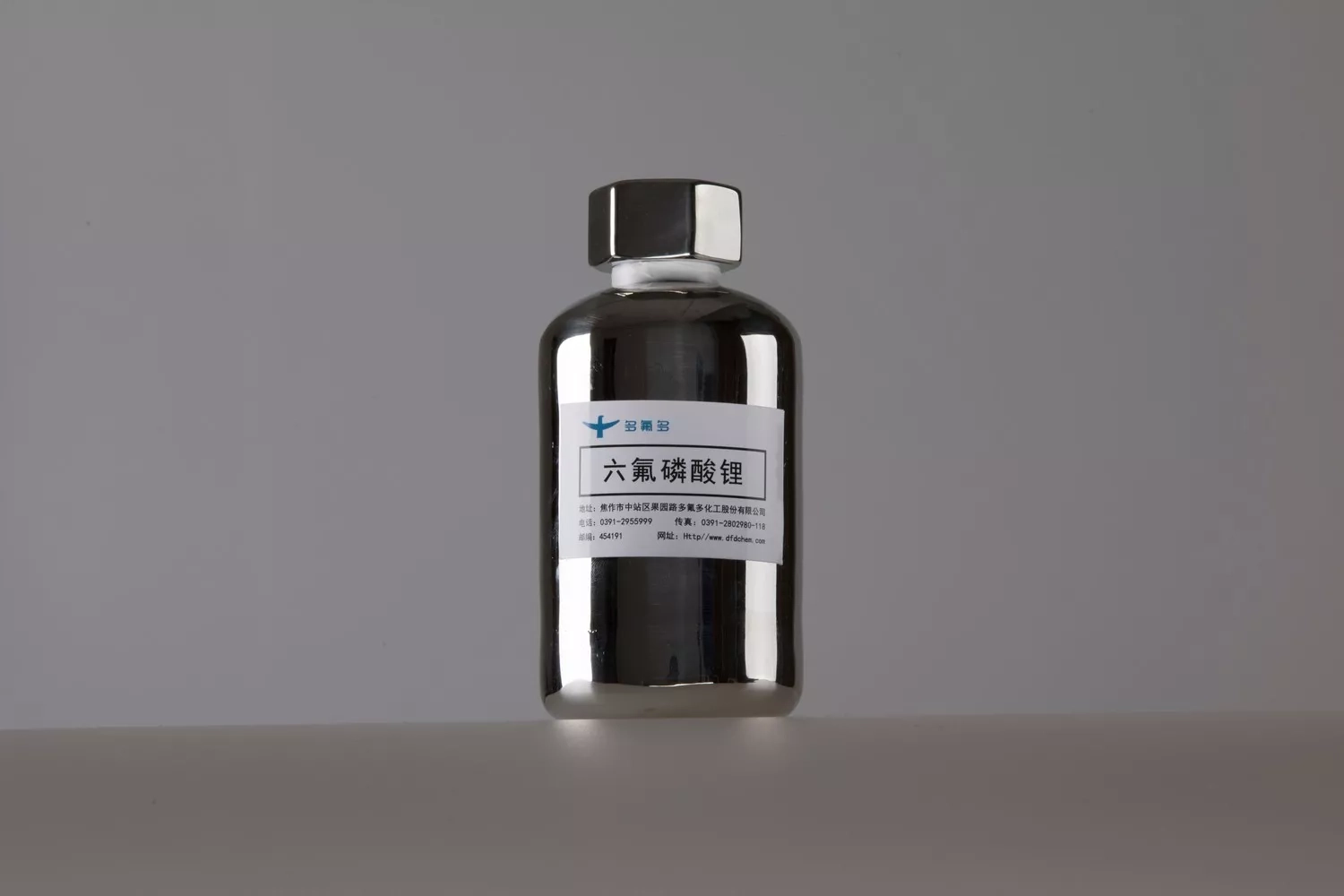
LiPF6 decomposition is a key stability issue in lithium-ion battery electrolyte systems. Lithium hexafluorophosphate, commonly known as LiPF6, is widely used as a lithium salt because it provides lithium ions and works effectively in carbonate-based electrolyte formulations. PubChem identifies lithium hexafluorophosphate by the molecular formula F6LiP, which provides a basic chemical identity reference for technical readers.
However, LiPF6 is not stable under all environmental conditions. Its performance depends on how well moisture, heat exposure, acid-related species, and impurities are controlled before it enters electrolyte formulation.
The mechanism is important. Under certain conditions, LiPF6 can be associated with decomposition-related species such as LiF and PF5. When moisture is present, phosphorus-fluorine species may react with water and promote the formation of HF and other acid-related products. This is why LiPF6 decomposition should not be treated only as a theoretical chemical reaction. It can change the chemical baseline of the electrolyte before cell production begins.
When water, HF, and acid-related species increase, the electrolyte may become harder to control in terms of acidity, interfacial reaction behavior, and batch-to-batch consistency.
At a Glance
| Stability Factor | Mechanism | Effect on Electrolyte Stability |
|---|---|---|
| Moisture / H2O | Participates in LiPF6 hydrolysis | May increase acid-related instability |
| HF | Forms through hydrolysis or acid-related pathways | May affect electrolyte acidity and interface environment |
| Temperature | Accelerates molecular-level side reactions | Narrows the usable stability window |
| Impurity profile | Adds extra ionic or reactive variables | May affect formulation consistency |
| Storage condition | Controls exposure before mixing | Helps preserve the tested quality state |
Why LiPF6 Decomposition Matters in Electrolyte Stability
LiPF6 Is Effective but Chemically Sensitive
LiPF6 is effective because it dissociates in suitable solvent systems and provides Li⁺ for ion transport. This supports lithium-ion movement between electrodes during charge and discharge.
Its limitation is that it has a defined stability boundary. When LiPF6 is exposed to moisture, heat, or unsuitable storage conditions, decomposition-related reactions may occur. The concern is not only that the material changes. The deeper issue is that the reaction products may alter the chemical state of the lithium salt before it is used in electrolyte production.
Before LiPF6 enters electrolyte formulation, its stability must be maintained through moisture protection, temperature control, and sealed storage. If moisture enters the material or the electrolyte system, LiPF6 may undergo hydrolysis and generate HF or other acid-related species. If storage temperature rises or packaging integrity weakens, moisture ingress and side reactions become more likely.
These changes may not appear as visible defects, but they can change the initial chemical state of LiPF6 before electrolyte mixing. For electrolyte formulation, changes in H2O, HF, and acid-related species may affect acidity, interface reaction conditions, and batch consistency.
Key Point:
LiPF6 is valuable because of its electrochemical compatibility. Its quality-control difficulty comes from moisture sensitivity, hydrolysis risk and acid-related decomposition pathways.
Electrolyte Stability Depends on More Than Purity
High purity is necessary for battery-grade LiPF6, but purity alone cannot explain electrolyte stability.
Main content confirms the effective LiPF6 level. It does not show whether the material has absorbed moisture, whether acid-related species have increased, or whether trace impurities are under control.
For electrolyte stability, the starting chemical state matters. If LiPF6 enters the formulation with higher moisture or acid-related indicators, the electrolyte may begin with a less stable baseline. This does not mean immediate failure. It means the formulation becomes more sensitive to solvent quality, additive balance, process conditions, and storage exposure.
A more professional question is not only:
Is the LiPF6 pure enough?
It should also be:
Has the LiPF6 remained chemically stable before entering the electrolyte system?
LiPF6 Decomposition Narrows the Stability Window
A stable electrolyte formulation depends on predictable raw materials. When the LiPF6 decomposition risk increases, the stability window becomes narrower.
The mechanism is cumulative. Moisture may promote LiPF6 hydrolysis. Hydrolysis may increase HF and acid-related species. Acid-related species may influence electrode interface reactions. Trace impurities may add another layer of variability.
These factors may not act independently. They can reinforce each other and reduce process tolerance.
For electrolyte manufacturers, this means the same formulation may become more sensitive to small changes in water, acidity, temperature exposure, and impurity profile. The result is often not a visible defect, but higher control difficulty and weaker batch-to-batch predictability.
How Moisture Triggers LiPF6 Hydrolysis
Moisture Is a Chemical Trigger, Not Only Contamination
Moisture is one of the most important triggers for LiPF6 instability.
This issue may appear in technical searches as LiPF6 hydrolysis, LiPF6 reaction with water, lithium hexafluorophosphate reaction with water, or LiPF6 H2O sensitivity. These expressions describe the same core mechanism: water is not only a physical impurity. It is a reactive variable.
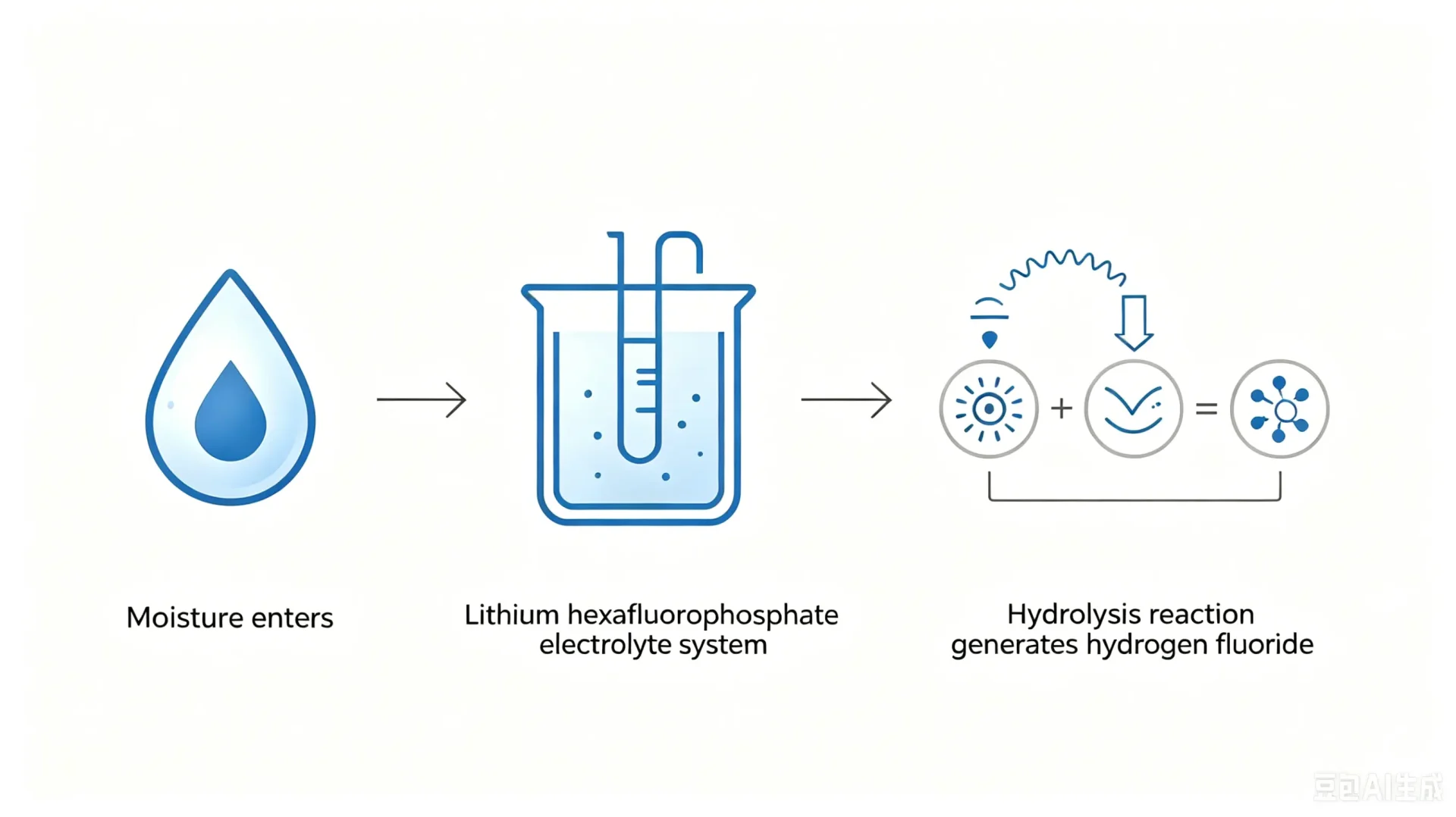
When water enters LiPF6 or the electrolyte system, it may participate in hydrolysis reactions. A simplified explanation is that moisture can react with phosphorus-fluorine species and promote the formation of HF and other acid-related products. The exact pathway depends on water level, solvent environment, temperature, and storage history, but the industry concern is consistent: moisture can shift the electrolyte toward a less controlled chemical state.
This is why H2O should not be treated as a minor specification. It is directly connected with LiPF6 hydrolysis risk and the acid-related baseline of the final electrolyte.
LiPF6 Reaction with Water Increases Acid-Related Risk
The key concern in the LiPF6 reaction with water is not only that a reaction occurs. The concern is what the reaction produces and how those products affect the electrolyte system.
When LiPF6 hydrolysis proceeds, HF and other acid-related species may form. HF is important because it can increase electrolyte acidity and participate in secondary reactions near electrode interfaces.
In lithium-ion batteries, the electrolyte is not a passive liquid. It supports ion transport, but it also participates in interfacial film formation and side reactions. When acid-related species increase, the interfacial reaction environment may become less predictable.
This mechanism explains why moisture control must begin before electrolyte mixing. If LiPF6 has already absorbed moisture or generated acid-related species before formulation, the electrolyte starts from a less controlled chemical baseline. The formulation team then needs to manage higher sensitivity during mixing, storage, and cell application.
In this sense, LiPF6 hydrolysis is not just a chemical fact. It is a stability pathway connecting moisture exposure with electrolyte consistency.
Moisture Control Should Begin Before Mixing
Moisture control is often discussed during electrolyte production, but for LiPF6, it must begin earlier.
The control chain includes:
synthesis → purification → drying → packaging → transportation → storage → sampling → mixing
Each step can either reduce or increase the probability of water entering the material. Once water enters, the material may no longer have the same chemical baseline as the tested batch. Even if the main content remains high, acid-related indicators may already have changed.
Drying and sealed packaging reduce water ingress. Controlled storage reduces moisture absorption and temperature-driven side reactions. Controlled sampling reduces exposure time.
Together, these controls help LiPF6 preserve the quality state reflected in COA data.
How HF Formation Affects Electrolyte Stability
LiPF6 HF Risk Is an Acid-Related Stability Signal
LiPF6 HF risk is often discussed as a safety issue. That is correct, but it is not the whole picture.
In electrolyte stability analysis, HF is also a chemical signal. It may indicate that moisture exposure, hydrolysis or acid-related decomposition pathways have occurred.
The mechanism is that HF can change the acidic environment of the electrolyte. A more acidic environment may influence solvent stability, additive response, and electrode interface chemistry. Therefore, HF should not be read only as a hazard label. It should also be interpreted as a stability-related indicator.
A controlled HF level means the electrolyte formulation starts from a more predictable acid-related baseline. A fluctuating HF level means the formulation may become more sensitive to process and storage conditions.
HF May Influence Electrolyte Acidity and Interface Reactions
Electrolytes do more than conduct Li⁺. They also participate in the formation and maintenance of interfacial layers on electrode surfaces.
When HF or other acid-related species increase, the local chemical environment near the electrode interface may change. This may influence side reactions, interface film formation, and long-term electrochemical stability.
The effect should not be overstated as “HF always causes failure.” A more accurate explanation is that HF can increase the difficulty of maintaining consistent electrolyte behavior.
The mechanism can be summarized as:
higher moisture → higher hydrolysis risk → higher HF / acid-related species → less predictable interface environment → tighter formulation control required
This is why H2O and HF should be read together. H2O reflects the trigger. HF reflects part of the chemical response.
HF Control Supports Formulation Consistency
For electrolyte manufacturers, consistency is often more important than one isolated test result.
A stable electrolyte requires a stable acid-related baseline. If HF remains controlled, the formulation team can better predict how the electrolyte will behave during mixing, storage, and cell use. If HF varies from batch to batch, the same formulation may respond differently to solvents, additives, or electrode materials.
In the context of LiPF6 decomposition, H2O and HF are linked indicators. H2O reflects moisture control before electrolyte production. HF reflects the acid-related response that may result from hydrolysis or exposure.
When both indicators are controlled, LiPF6 is more likely to maintain a stable chemical baseline for electrolyte formulation.
How Temperature and Storage Conditions Influence LiPF6 Decomposition
Decomposition Temperature Is a Boundary, Not a Storage Target
Decomposition temperature helps define the thermal stability boundary of LiPF6, but it should not be treated as the recommended storage temperature.
Temperature affects molecular motion and reaction rates. Higher temperatures can increase the probability of decomposition-related pathways and accelerate side reactions, especially when moisture or incompatible materials are present.
The SDS you provided lists a decomposition temperature range and also states that LiPF6 should avoid moisture, heat, flames, sparks, and incompatible substances. It also requires sealed storage in a cool, dry, and ventilated environment.
Therefore, decomposition temperature defines the upper risk boundary. Daily storage requirements define the practical control conditions.
Heat and Moisture Can Work Together
Heat is not an isolated risk. In many storage situations, heat exposure works together with moisture exposure.
If packaging is not properly sealed, higher temperatures may increase moisture transfer, accelerate hydrolysis-related reactions and narrow the usable stability window. If the environment is dry and sealed, the material is more likely to preserve its tested quality state.
This explains why storage control is part of electrolyte stability management. Poor storage can change the material before it enters formulation. Proper storage reduces the probability of water ingress, hydrolysis and acid-related shift.
For LiPF6, “cool and dry storage” is not generic warehouse language. It is a chemical stability requirement.
Sealing, Dryness, and Heat Avoidance Preserve the Chemical Baseline
The basic control logic for LiPF6 is:
- keep it sealed;
- keep it dry;
- keep it away from heat;
- reduce unnecessary exposure;
- avoid incompatible materials.
These controls reduce the inputs that promote LiPF6 decomposition. Sealing limits water and air exposure. Dry storage reduces hydrolysis probability. Heat avoidance slows reaction pathways. Shorter exposure time limits moisture uptake during sampling or mixing.
Without these controls, COA data may describe the material at the time of testing, but not necessarily its condition at the time of use.
Which Quality Indicators Reflect LiPF6 Stability Risk
H2O Reflects Moisture Control
H2O is one of the most direct indicators of LiPF6 stability risk because it is connected to the first step of the hydrolysis pathway.
Higher water content increases the probability that LiPF6 or its decomposition-related species will participate in hydrolysis reactions. This may lead to higher acid-related species and reduce the predictability of the electrolyte baseline.
In the COA you provided, moisture is listed as a specific quality item and tested by Karl-Fischer titration. HF is also tested separately by acid-base titration. This shows that water and acid-related responses are measurable quality indicators, not general descriptions.
For electrolyte stability, H2O should be read as a mechanism-related indicator, not only a specification number.
HF Reflects Acid-Related Stability Risk
HF reflects the acid-related side of LiPF6 stability.
Hydrolysis or exposure-related reactions may produce HF or increase acid-related species. These species can affect electrolyte acidity and interface behavior. Therefore, HF is not only a safety concern. It is also a stability signal.
HF should be interpreted together with H2O. If H2O is the trigger indicator, HF is part of the response indicator. When both are controlled, LiPF6 is more likely to support a stable electrolyte formulation.
If HF fluctuates while the main content remains high, the material may still require attention because the acid-related baseline has changed.
Impurity Profile Supports Electrolyte Consistency
Impurity profile affects electrolyte consistency because ions introduced with the lithium salt may add uncontrolled variables to the formulation.
This mechanism should not be exaggerated. Not every trace impurity will directly cause performance failure. However, uncontrolled cations and anions may influence the conductivity environment, side reaction sensitivity, or batch reproducibility.
A professional LiPF6 COA often separates cation and anion items. Your COA includes cation indicators such as Fe, K, Na, Ca, Ni, Pb, Cr, and Cu, and anion indicators such as sulfate and chloride.
This indicator set shows that battery-grade LiPF6 quality is not only about the main content. It is also about impurity control depth and batch consistency.
Main Content Is Necessary but Not Sufficient
Main content remains important because it confirms the effective LiPF6 purity level.
However, electrolyte instability is not controlled by the main content alone. Moisture can trigger hydrolysis. HF can reflect acid-related response. Impurities can affect formulation reproducibility. Storage conditions can change the material after testing.
Therefore, the main content is a quality threshold, not a complete stability explanation.
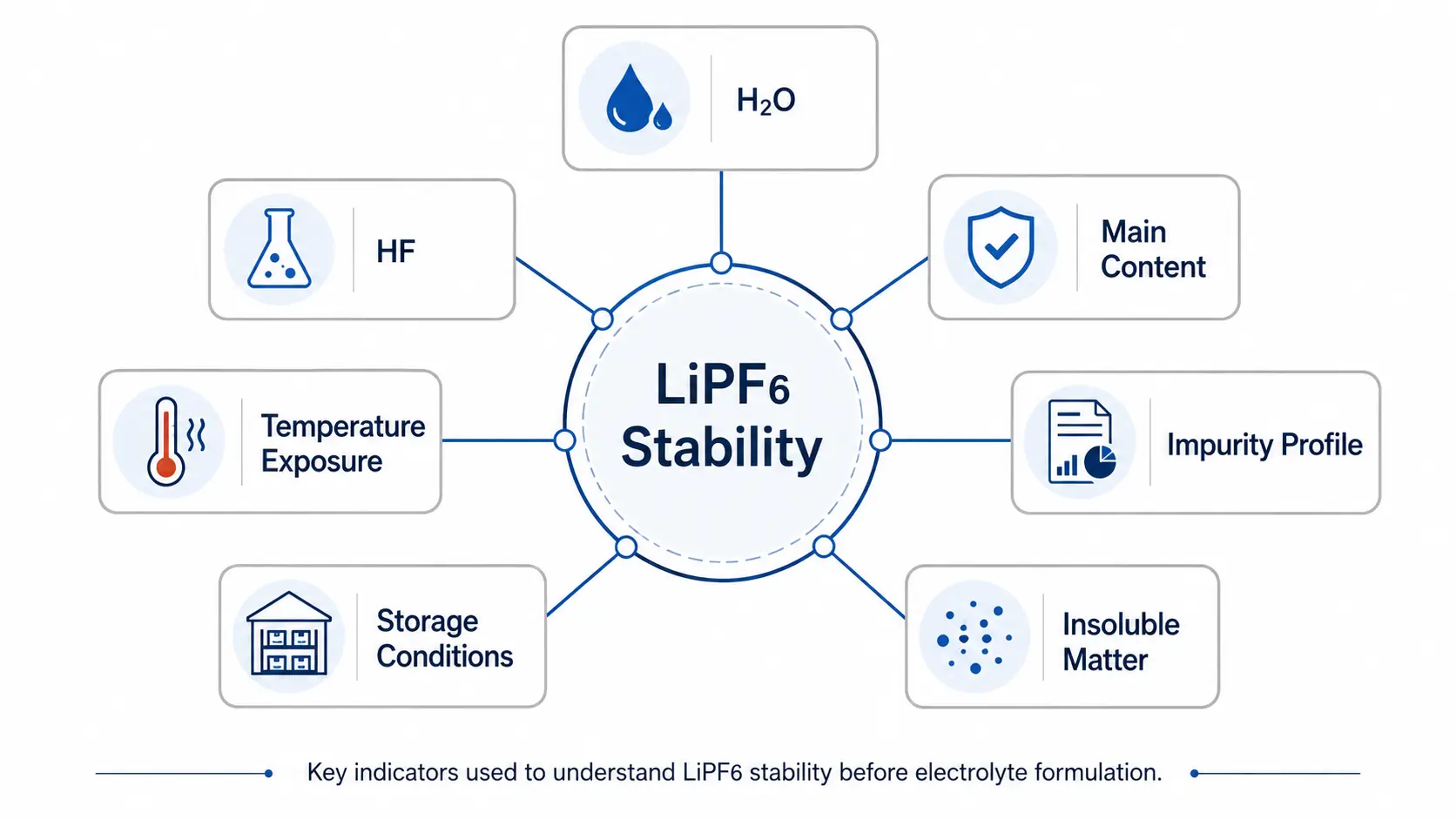
| Indicator | Mechanism Meaning | Stability Relevance |
|---|---|---|
| Main Content | Confirms effective LiPF6 level | Basic purity threshold |
| H2O | Shows water available for hydrolysis | Moisture-triggered instability |
| HF | Shows acid-related response | Electrolyte acidity and interface sensitivity |
| Impurity Profile | Shows cation/anion control | Formulation consistency |
| Insoluble Matter | Shows cleanliness and dissolution behavior | Process control observation |
| Storage Conditions | Shows protection after testing | Preservation of chemical baseline |
What LiPF6 Decomposition Means for Electrolyte Manufacturers
It Increases Formulation Control Difficulty
When LiPF6 decomposition risk increases, electrolyte formulation becomes harder to control.
Water, HF, and acid-related species change the starting chemical environment of the formulation. Solvents, additives, and electrode materials may respond differently when the acid-related baseline changes.
This does not mean every batch will fail. It means the formulation becomes less tolerant of variation.
For manufacturers, raw material control, mixing discipline, storage time management, and batch verification become more important.
It Raises Sensitivity During Storage, Sampling and Mixing
LiPF6 can change before formal electrolyte production begins.
The mechanism is exposure. During storage, sampling, or mixing, opened containers may allow moisture ingress. If exposure time is too long or the environment is not dry enough, the material may slowly move away from its tested state.
This explains why LiPF6 should be managed as a moisture-sensitive material throughout the pre-mixing process.
SDS storage guidance is therefore not only a safety instruction. It is also a stability-control boundary that helps preserve LiPF6 before formulation.
It Affects Long-Term Electrolyte Stability and Interface Management
LiPF6 decomposition matters because it can affect the electrolyte environment that interacts with electrodes.
Electrolytes participate in forming and maintaining interfacial layers. When acid-related species increase, the local reaction environment at electrode surfaces may become less predictable. This can increase the difficulty of maintaining stable long-term electrochemical behavior.
LiPF6 is not the only factor in battery performance. Solvent system, additives, electrode materials, and cell design also matter. However, because LiPF6 is the core lithium salt, its stability strongly influences how predictable the electrolyte baseline can be.
Conclusion
LiPF6 decomposition should be understood as an electrolyte stability issue, not only as a chemical reaction topic.
Its mechanism begins with moisture sensitivity. When water enters LiPF6 or the electrolyte system, it may promote LiPF6 hydrolysis and increase HF or other acid-related species. These species can shift electrolyte acidity, influence interface reaction conditions, and make formulation consistency harder to maintain.
Temperature and storage conditions add another layer of control. Decomposition temperature defines a thermal boundary, while daily stability depends on sealed packaging, dry storage, heat avoidance, and controlled exposure.
For battery-grade LiPF6, the main content is necessary but not sufficient. H2O, HF, impurity profile, insoluble matter, color, and SDS-defined storage conditions together provide a more complete stability picture.
The more tightly these factors are controlled, the more reliably LiPF6 can support electrolyte formulation consistency and long-term battery material quality.
FAQ
Why is LiPF6 sensitive to moisture?
LiPF6 is sensitive to moisture because water can participate in hydrolysis reactions. This may promote HF and other acid-related species, shifting the electrolyte’s chemical baseline before mixing.
What happens when LiPF6 reacts with water?
LiPF6 reaction with water may trigger hydrolysis and increase acid-related products such as HF. The main issue is how these acid-related species affect electrolyte acidity, interface reactions, and formulation consistency.
Does LiPF6 HF always mean electrolyte failure?
No. LiPF6 HF risk does not automatically mean immediate electrolyte failure. HF should be understood as an acid-related stability signal. The key question is whether H2O, HF, and other quality indicators remain within the electrolyte system’s control window.
Is decomposition temperature the same as recommended storage temperature?
No. Decomposition temperature is a thermal stability boundary, not a recommended storage temperature. LiPF6 should be stored under controlled SDS conditions, including sealed, dry, and cool storage away from moisture and heat.
Why can’t LiPF6 stability be judged only by the main content?
Main content confirms basic purity, but LiPF6 stability also depends on moisture, HF, impurity profile, storage conditions, and exposure control. These factors influence hydrolysis risk, acid-related response, and electrolyte consistency.
CTA
Looking for battery-grade LiPF6 with controlled moisture and reliable COA/SDS support?
Henan Non-Ferrous Metals Industry Co., Ltd. is an authorized trading subsidiary of Duofluoride Chemicals Co., Ltd., a leading global fluorochemical producer.
For LiPF6 specifications, packaging, and supply support, please contact us.