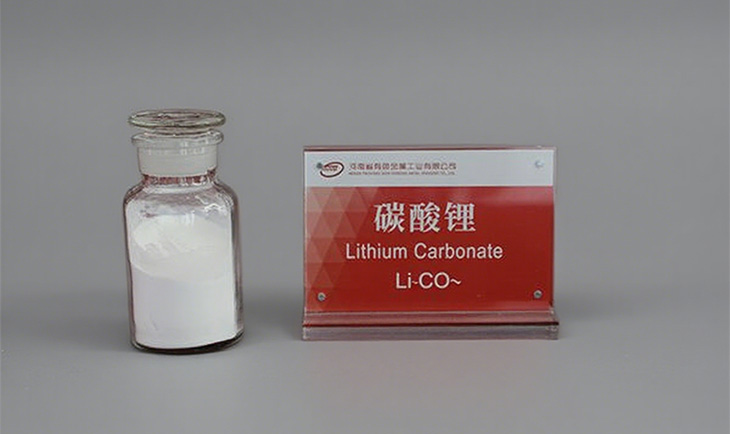
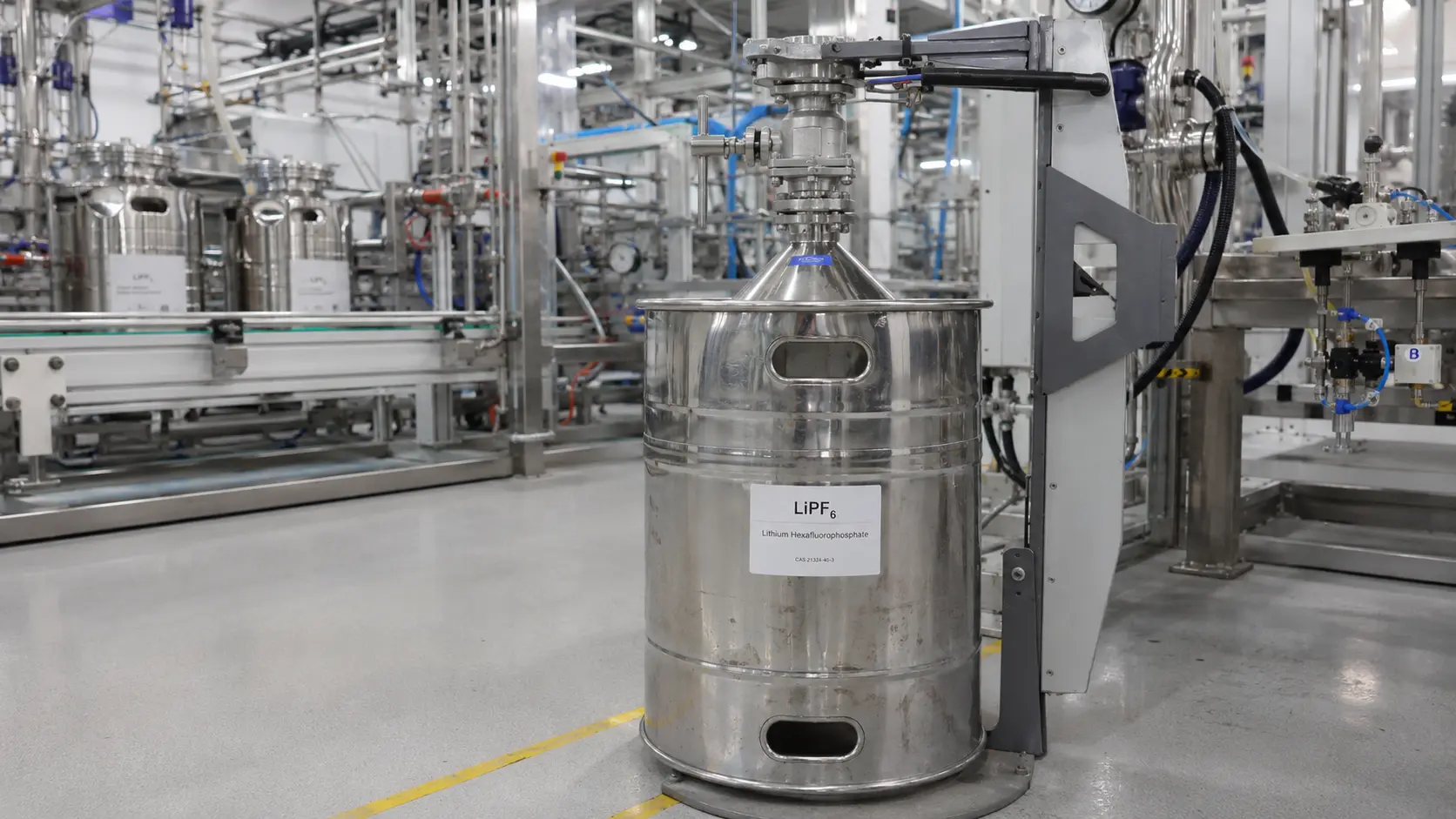
Lithium hexafluorophosphate, commonly expressed as LiPF6, is an inorganic lithium salt used as a conducting salt in lithium-ion battery electrolyte systems. Its CAS number is 21324-40-3. In industrial battery materials, LiPF6 is not a standalone electrolyte, nor is it a battery component in the same sense as cathode, anode, separator, or current collector. Its function is more specific: it supplies lithium ions within a solvent-based electrolyte and helps define the electrochemical environment in which ion transport and interfacial reactions occur.
A lithium-ion battery electrolyte is a formulated system. It normally contains a lithium salt, organic solvents, and functional additives. In this system, LiPF6 provides the lithium salt foundation; carbonate solvents provide the liquid transport medium; additives regulate film formation, gas generation, high-voltage stability, or safety behavior. The performance of a LiPF6 electrolyte therefore, depends not only on the presence of LiPF6 but also on how the salt interacts with solvent molecules, electrode surfaces, trace water, acidic species, and manufacturing conditions.
For battery materials, battery-grade lithium hexafluorophosphate is better understood as a performance-sensitive raw material rather than a simple chemical commodity. Its quality indicators are not isolated purchasing parameters. Purity, moisture, acidity-related species, metal impurities, and insoluble matter all relate to electrolyte stability, cell formation behavior, storage control, and production repeatability.
What Is Lithium Hexafluorophosphate?
Lithium hexafluorophosphate is the full chemical name of LiPF6. The salt consists of lithium cations, Li⁺, and hexafluorophosphate anions, PF6⁻. In lithium-ion battery electrolytes, LiPF6 is dissolved in organic carbonate solvent systems to form an ion-conducting liquid phase.
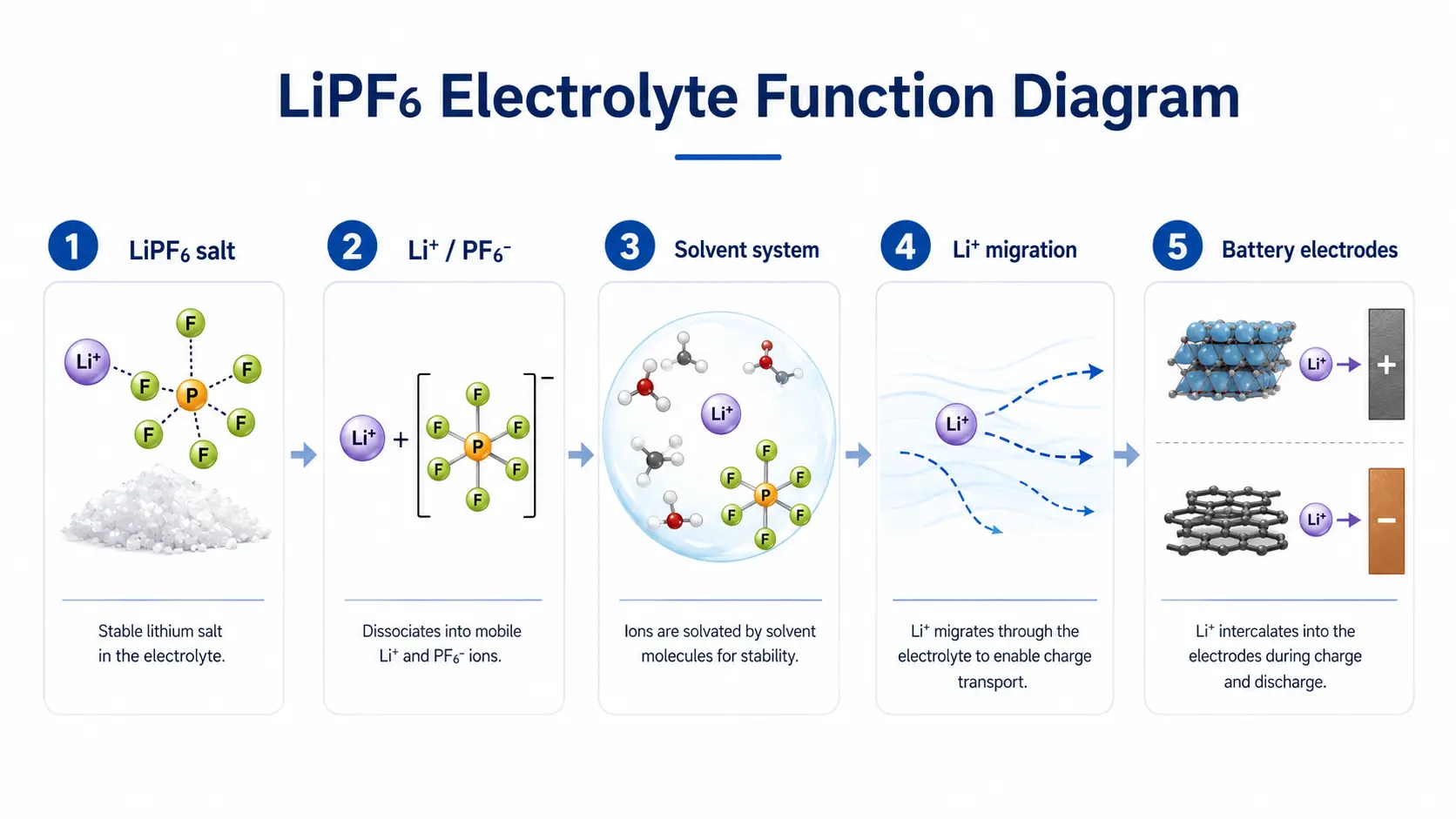
The most important point is that LiPF6 does not work as a solid salt inside the battery. Its practical function begins after dissolution. Once dissolved, Li⁺ becomes solvated by surrounding solvent molecules, while PF6⁻ remains as the counter anion. The movement, coordination, and desolvation behavior of Li⁺ influence how efficiently lithium ions migrate through the electrolyte and enter or leave electrode materials.
In technical and commercial documents, the material may appear under several expressions:
| Expression | Industrial Meaning |
|---|---|
| Lithium hexafluorophosphate | Full chemical name |
| LiPF6 | Chemical formula and industry abbreviation |
| LiPF6 salt | Lithium salt used in electrolyte systems |
| LiPF6 electrolyte | Electrolyte system containing LiPF6 |
| Lithium hexafluorophosphate electrolyte | Electrolyte application of LiPF6 |
| Battery grade lithium hexafluorophosphate | Grade intended for lithium-ion battery material use |
For international material identification, the product is commonly specified as:
Battery Grade Lithium Hexafluorophosphate (LiPF6) CAS 21324-40-3
The chemical name, formula, CAS number, and grade description should remain consistent in technical specifications, batch records, product labels, and safety documents.
How LiPF6 Functions as an Electrolyte Salt
Ion Transport Is Based on Solvation and Desolvation
In a lithium-ion battery, Li⁺ must move between the positive and negative electrodes during charge and discharge. This movement does not occur as free lithium ions traveling through empty liquid space. In carbonate-based electrolyte systems, Li⁺ is surrounded by solvent molecules and forms solvated structures.
During battery operation, Li⁺ migration involves several linked steps:
- dissolution of LiPF6 in the solvent system;
- formation of solvated Li⁺ species;
- migration through the liquid electrolyte;
- desolvation at the electrode interface;
- insertion into or extraction from electrode materials.
Each step can be influenced by solvent composition, salt concentration, temperature, additive chemistry, and electrode surface condition. This is why LiPF6 is not evaluated only by chemical identity. The salt must support a stable ionic environment within a formulated electrolyte system.
PF6⁻ Is More Than a Passive Counter Ion
PF6⁻ is often described as the counter anion to Li⁺, but its role is not completely passive. The size, coordination behavior, and stability of PF6⁻ affect ion association, salt dissociation, conductivity, and side-reaction pathways. Under normal conditions, PF6⁻ helps form a usable lithium salt system in carbonate solvents. Under moisture or thermal stress, however, PF6⁻-related decomposition pathways become important.
This dual character explains why LiPF6 is both commercially successful and chemically sensitive. It provides a mature electrolyte salt system, but it also requires strict control of water, acidic species, heat exposure, and storage conditions.
Why LiPF6 Remains the Mainstream Salt in Lithium-Ion Batteries
LiPF6 is widely used because it provides a practical balance among conductivity, solvent compatibility, interfacial behavior, aluminum current collector stability, and industrial maturity. Its position in commercial lithium-ion batteries is not based on a single perfect property, but on a set of balanced advantages.
Conductivity and Solvent Compatibility
A lithium salt must dissolve sufficiently in the electrolyte solvent and provide enough mobile ions for charge transfer. LiPF6 performs well in common carbonate solvent systems used in commercial lithium-ion batteries. These systems often combine cyclic carbonates and linear carbonates to balance dielectric strength, viscosity, conductivity, low-temperature behavior, and film-forming behavior.
If a salt dissolves poorly, the number of mobile lithium ions is limited. If the solvent compatibility is weak, the electrolyte may show high viscosity, poor conductivity, unstable interfaces, or narrow operating tolerance. LiPF6 has become dominant because it offers workable conductivity and compatibility across many commercial formulations.
Interfacial Chemistry
Battery performance depends heavily on the electrode/electrolyte interface. During cell formation and cycling, electrolyte components react at electrode surfaces and form interfacial films. On the negative electrode, the solid electrolyte interphase, or SEI, affects lithium-ion transport, electron blocking, gas generation, and cycle stability. On the positive electrode, interfacial layers influence high-voltage stability and transition metal dissolution.
LiPF6 can contribute to interfacial products such as LiF-containing species. LiF is often associated with chemically stable and mechanically robust interfacial layers, although the final interface is controlled by the full electrolyte formulation and electrode chemistry. Solvents, additives, formation protocol, electrode surface structure, and operating voltage all affect the final film composition.
Aluminum Current Collector Compatibility
Commercial lithium-ion battery cathodes commonly use aluminum foil as the current collector. At high potentials, some electrolyte salt systems may cause or accelerate aluminum corrosion. LiPF6-based electrolytes have a mature application foundation with aluminum current collectors, which has supported their long-term use in commercial cells.
This does not mean the aluminum corrosion risk disappears in all LiPF6 systems. Voltage window, solvent selection, salt concentration, additives, temperature, and impurity level still matter. The industrial relevance of LiPF6 lies in its proven compatibility under established formulation and operating conditions.
Industrial Maturity
Material selection in battery manufacturing is not decided by laboratory performance alone. A salt must also support scale-up, quality control, safety documentation, transport, customer qualification, and long-term supply. LiPF6 has accumulated extensive industrial use, supplier experience, formulation data, and customer validation history.
For electrolyte producers, this maturity reduces development uncertainty. For battery manufacturers, it supports stable qualification pathways and repeatable production processes.
Stability Limits of Lithium Hexafluorophosphate
LiPF6 Is Chemically Useful but Not Fully Inert
LiPF6 is effective as an electrolyte salt because it works well in carbonate solvent systems. At the same time, it is not completely inert. Heat, trace moisture, acidic impurities, and electrode surfaces can trigger or accelerate decomposition reactions.
A commonly discussed equilibrium is:
LiPF6 ⇌ LiF + PF5
PF5 is a strong Lewis acid. In the presence of water, PF5 can react further and form phosphorus oxyfluoride species and HF. These products may alter electrolyte acidity, accelerate side reactions, and affect electrode interfaces.
Moisture Changes the Electrolyte Reaction Environment
Water is one of the most critical contaminants in LiPF6 systems. Even small amounts of moisture can shift the reaction environment. Moisture can promote LiPF6 hydrolysis, increase HF formation, and influence interface chemistry during cell formation and cycling.
For electrolyte production, moisture is not only a storage issue. It can affect formulation stability, analytical control, filtration requirements, acid balance, and batch repeatability. This is why moisture specification is one of the most important control points for battery-grade lithium hexafluorophosphate.
Thermal Exposure Accelerates Decomposition Risk
Elevated temperature can promote LiPF6 decomposition and related side reactions. Heat exposure during storage, transportation, or processing may increase the formation of reactive intermediates. When heat and moisture are both present, stability risks become more significant.
In industrial handling, this makes packaging integrity, low-moisture storage, temperature control, and limited exposure after opening essential parts of LiPF6 management.
Lithium Hexafluorophosphate Electrolyte and Battery Applications
A lithium hexafluorophosphate electrolyte is an electrolyte system that uses LiPF6 as its lithium salt component. The complete electrolyte still requires solvents and additives. LiPF6 provides the ion-conducting salt foundation, while the rest of the formulation adjusts conductivity, viscosity, interfacial behavior, high-voltage tolerance, low-temperature performance, and safety characteristics.
The term LiPF6 battery does not refer to a separate battery type. It usually describes lithium-ion battery systems that use LiPF6-based electrolytes. These systems may appear in electric vehicles, energy storage systems, consumer electronics, power tools, and other rechargeable lithium-ion applications.
Different applications place different emphasis on electrolyte behavior:
| Battery Application | Electrolyte System Priorities |
|---|---|
| Electric vehicle batteries | Reliability, environmental tolerance, and predictable material quality |
| Energy storage batteries | Calendar life, stability, cost control, long-term material supply |
| Consumer electronics batteries | Energy density, fast charging tolerance, safety, compact cell design |
| High-nickel cathode systems | Moisture control, HF suppression, interface stability, impurity control |
| Industrial lithium-ion systems | Reliability, environmental tolerance, predictable material quality |
LiPF6 does not independently determine these results, but its quality influences the baseline electrolyte environment. Moisture, acidic species, trace metals, and insoluble residues can all affect how the electrolyte behaves during preparation, storage, formation, and long-term operation.
How to Understand Battery Grade Lithium Hexafluorophosphate Specifications
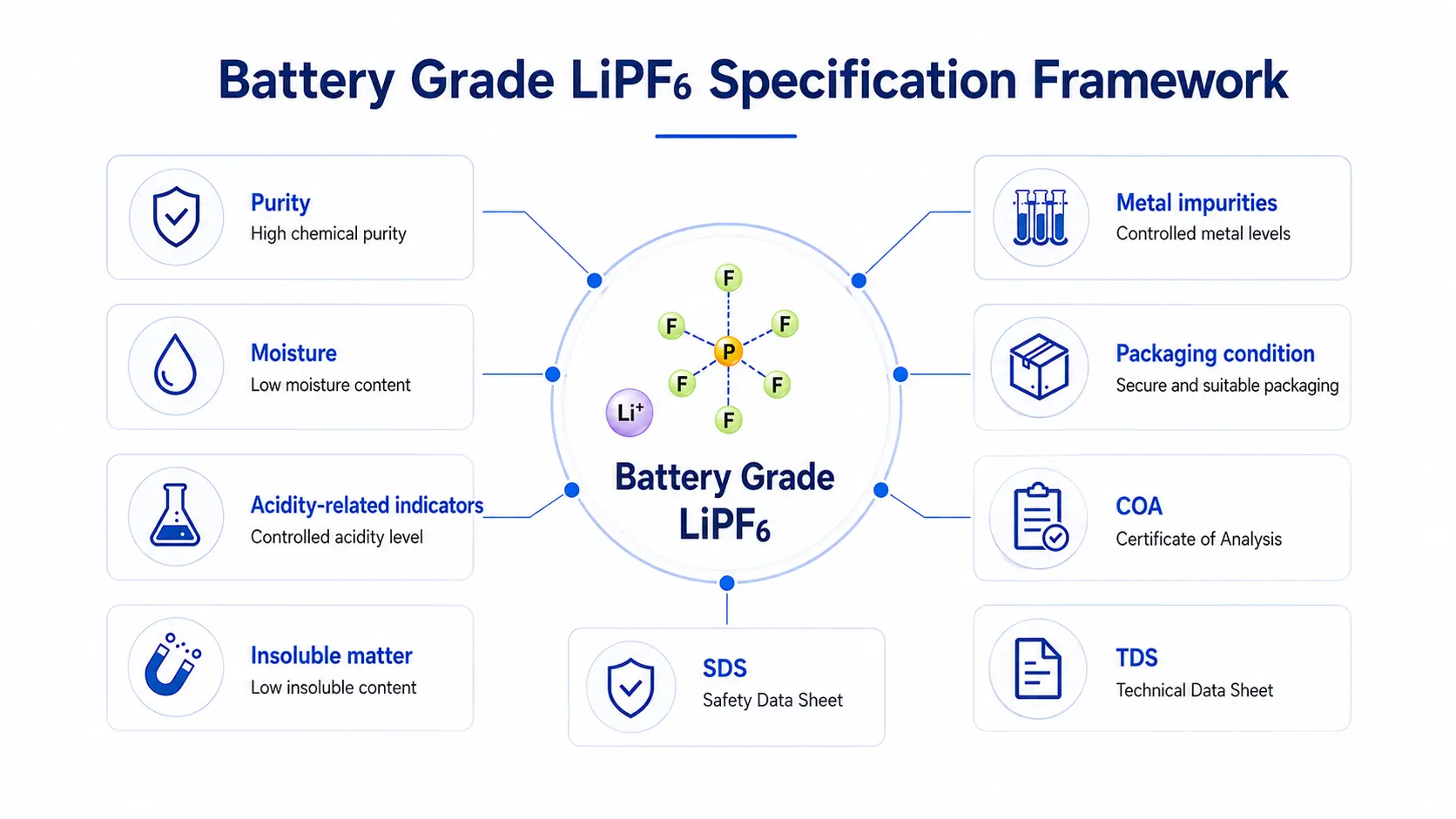
Battery-grade LiPF6 specifications should be read as control points for electrolyte performance, not as a simple chemical checklist. Each major specification is linked to a specific risk in electrolyte preparation or battery manufacturing.
Purity
Purity indicates the main active content of LiPF6. Higher purity generally reduces unnecessary side components in the electrolyte system. However, a high purity value alone is not enough. A material with high assay but unstable moisture, acid level, or trace metal profile may still create downstream risk.
Moisture
Moisture is directly connected with hydrolysis and HF-related side reactions. In electrolyte manufacturing, moisture control affects acid balance, side-reaction rate, and storage stability. For LiPF6, this parameter often carries more practical significance than it would in many general industrial chemicals.
Acidity-Related Indicators
Acidity-related indicators help reflect the presence or formation tendency of acidic species. These species may influence electrode interfaces, accelerate certain degradation reactions, and increase handling sensitivity. They are especially important when LiPF6 is used in high-performance electrolyte systems.
Metal Impurities
Trace metal impurities may participate in undesired redox reactions or influence interfacial chemistry. Their impact depends on battery chemistry, electrolyte formulation, and concentration level, but battery-grade materials generally require stricter trace metal control than ordinary chemical grades.
Insoluble Matter
Insoluble residues can affect filtration, cleanliness, and process stability during electrolyte production. In large-scale manufacturing, even small fluctuations can increase filtration load, analytical review, and production adjustment.
Packaging Condition
For LiPF6, packaging is part of material quality protection. Moisture-barrier performance, sealing condition, inert protection if required, and controlled opening procedures help preserve the material state before use.
Product Documents for Battery-Grade LiPF6
Product documents should support technical evaluation rather than replace it.
| Document | Function |
|---|---|
| TDS | Defines typical specification ranges and material grade |
| COA | Confirms actual test results for a specific batch |
| SDS/MSDS | Provides hazard, storage, transport, and handling information |
TDS explains what the product is designed to meet. COA verifies the delivered batch. SDS describes safe handling and storage requirements. For electrolyte-grade applications, these documents should be reviewed together because they answer different technical and operational questions.
FAQ About Lithium Hexafluorophosphate and LiPF6
1. Is lithium hexafluorophosphate the same as LiPF6?
Yes. Lithium hexafluorophosphate is the full English chemical name, while LiPF6 is the chemical formula. The CAS number is 21324-40-3. In technical files, quotations, product labels, and batch documents, the name, formula, CAS number, and material grade should match.
2. Why is LiPF6 commonly used in lithium-ion battery electrolytes?
LiPF6 is commonly used because it offers a balanced combination of solubility, ionic conductivity, carbonate solvent compatibility, interfacial behavior, aluminum current collector compatibility, and industrial maturity. It is not perfect in every property, but it provides a practical and well-established salt system for commercial lithium-ion batteries.
3. What specifications matter most for battery-grade lithium hexafluorophosphate?
Key specifications include purity, moisture, acidity-related indicators, metal impurities, insoluble matter, appearance, and packaging condition. Moisture and acidity-related indicators are especially important because they are linked to LiPF6 decomposition, HF formation, and electrolyte stability.
4. Why is moisture control critical for LiPF6?
LiPF6 is sensitive to moisture. Water can promote hydrolysis and PF5-related side reactions, leading to HF and other degradation products. In electrolyte production, moisture can influence formulation stability, interfacial chemistry, acid balance, and batch repeatability.
5. What should buyers check before choosing a LiPF6 supplier?
Buyers should confirm whether the product is suitable for battery-grade electrolyte applications, whether the COA matches the delivered batch, whether TDS and SDS documents are available, and whether packaging is designed to protect moisture-sensitive material. For long-term use, batch stability, export documentation, and technical response capability are also important.
CTA: Request Battery Grade Lithium Hexafluorophosphate Specifications
If you are evaluating battery-grade lithium hexafluorophosphate for lithium-ion battery electrolyte production, Henan Non-Ferrous Metals Industry Co., Ltd. can provide LiPF6 product specifications, COA/TDS/SDS documentation, packaging information, and export supply coordination.
Henan Non-Ferrous Metals Industry Co., Ltd. is the authorized trading subsidiary of Duofluoride Chemicals Co., Ltd., a Shenzhen-listed fluorochemical producer with strong LiPF6 production capability and global fluorochemical supply experience.