Lithium-ion battery cathode materials can be classified in several ways, including crystal structure, chemical composition, and commercial application. For most readers, however, the clearest starting point is a practical commercial overview.
In this type of overview, cathode materials are usually introduced through several commonly referenced chemistry families, including Lithium Cobalt Oxide (LCO), Lithium Manganese Oxide (LMO), Lithium Iron Phosphate (LFP), and ternary layered oxides. Among ternary materials, lithium nickel manganese cobalt oxide (NMC, also called NCM) and lithium nickel cobalt aluminum oxide (NCA) are the most widely discussed examples.
This approach is not meant to replace every technical classification method. Instead, it gives readers a clear way to understand the main cathode families before moving into more detailed chemical differences
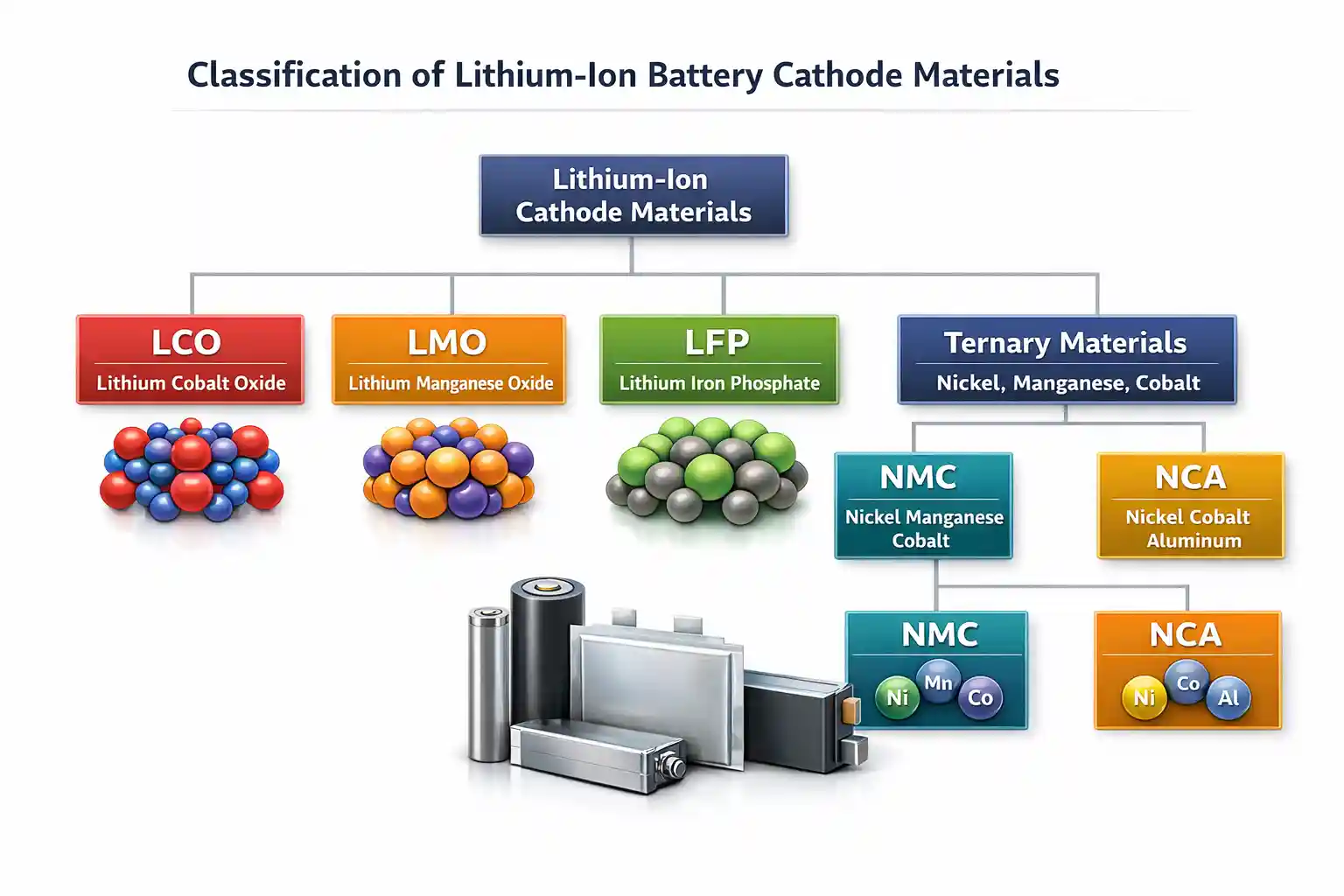
Four Main Commercial Categories of Lithium-Ion Cathode Materials
Lithium Cobalt Oxide (LCO)
Lithium Cobalt Oxide (LCO) is one of the earliest commercial lithium-ion cathode materials and played an important role in the development of modern lithium-ion batteries. It is commonly associated with relatively high energy density and has long been important in compact battery designs.
In industry discussions, LCO is often used as a reference chemistry when explaining the early development of lithium-ion cathode materials. Although it is no longer the only important cathode system, it still remains relevant, especially in discussions related to consumer electronics and portable devices.
Lithium Manganese Oxide (LMO)
Lithium Manganese Oxide (LMO) belongs to the spinel cathode family. It is commonly included among the standard lithium-ion cathode chemistries and is often discussed in comparisons between safety and power-oriented performance.
Compared with some newer high-energy cathode systems, LMO has a more limited role as a standalone chemistry in demanding applications. Even so, it remains useful in technical comparisons and is still relevant when discussing practical trade-offs between safety, cost, and battery design requirements.
Lithium Iron Phosphate (LFP)
Lithium Iron Phosphate (LFP) is the best-known olivine cathode material. Compared with more energy-dense nickel-rich chemistries, LFP generally offers lower energy density, but it is widely valued for its thermal stability, cycle life, and cost advantages.
Because of this balance, LFP has become one of the most important cathode chemistries in many commercial discussions. It is especially relevant in applications where safety, durability, and cost control are more important than achieving the highest possible energy density.
Ternary Cathode Materials
Ternary cathode materials mainly refer to layered oxide systems based on nickel, cobalt, and additional stabilizing metals. The two best-known commercial examples are lithium nickel manganese cobalt oxide (NMC/NCM) and lithium nickel cobalt aluminum oxide (NCA).
These materials are often discussed separately from LCO, LMO, and LFP because they offer more flexibility in balancing energy density, thermal behavior, cost, and design targets. In practical battery discussions, ternary cathodes are especially important in applications where higher energy density is a major consideration.
Why This Classification Matters
Cathode Chemistry Affects Battery Performance
Cathode materials do not only determine battery chemistry names. They also have a direct influence on energy density, thermal stability, cycle life, cost, and application suitability.
This is why cathode classification matters in both technical and commercial discussions. For readers trying to understand lithium-ion batteries, the cathode chemistry is often one of the most useful starting points because it helps explain why different battery systems behave differently in real applications.
Broad Categories Help Readers Understand the Market
For general readers, broad chemistry categories are easier to understand than a long list of specific formulations. A top-level structure helps explain the main differences first, while more detailed chemical distinctions can be introduced later.
This is also why many overview articles begin with a small number of major cathode families before moving into subtypes such as NMC111, NMC622, or NMC811. The goal is not to oversimplify the science, but to make the classification easier to follow.
Key Comparison of Major Lithium-Ion Cathode Materials
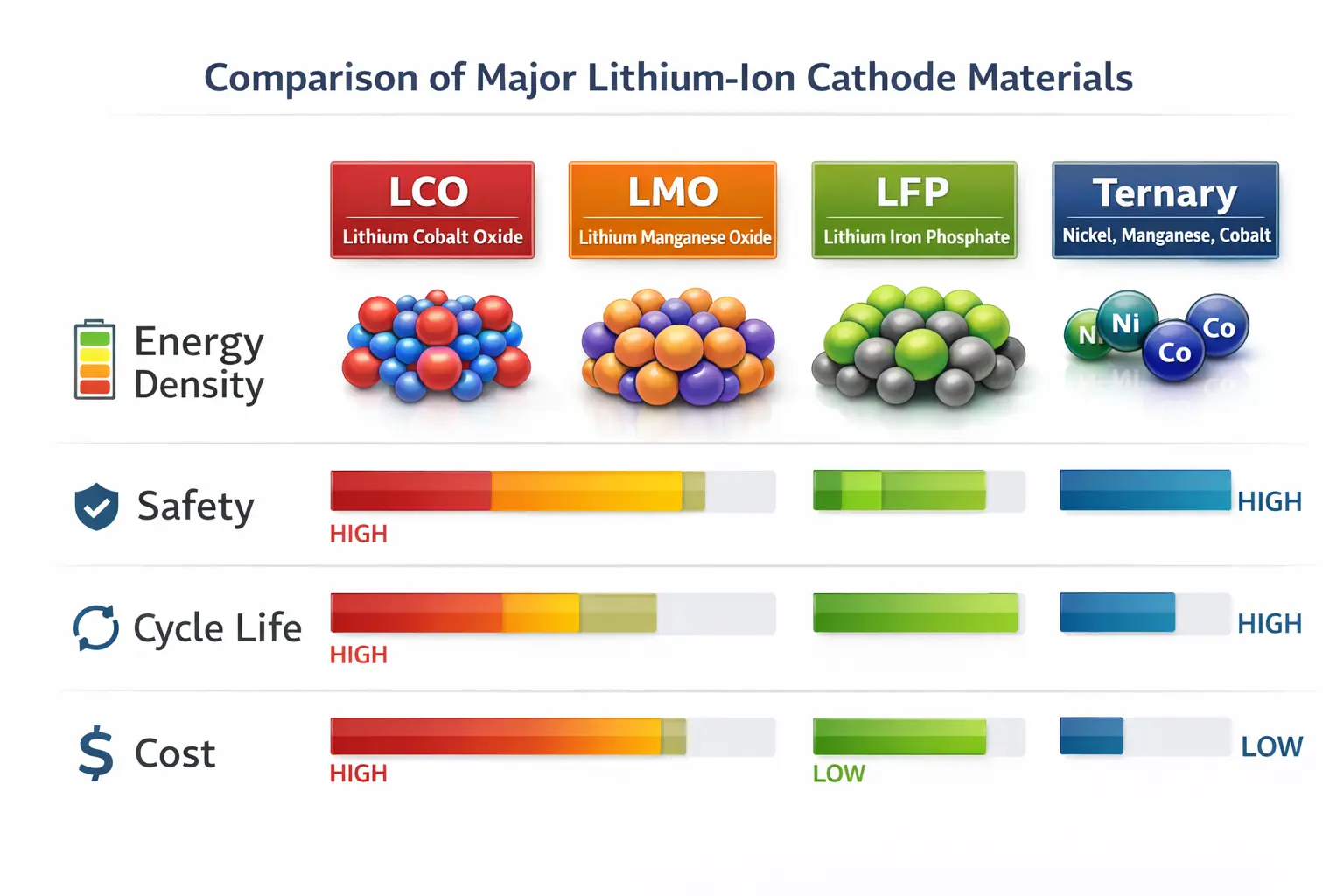
After reviewing the main cathode families, it is helpful to compare them side by side. Different materials offer different balances of energy density, safety, cycle life, and application suitability.
| Cathode Material | Main Advantages | Main Limitations | Typical Application Direction |
|---|---|---|---|
| Lithium Iron Phosphate (LFP) | Strong thermal stability, good safety performance, long cycle life, and lower cobalt dependence | Lower energy density than some nickel-rich cathode systems | Energy storage systems, commercial vehicles, and cost-sensitive EV applications |
| Lithium Manganese Oxide (LMO) | Good safety, relatively low cost, and useful power capability | More limited long-term use as a standalone chemistry in high-energy applications | Power-oriented battery systems and some blended cathode applications |
| Lithium Cobalt Oxide (LCO) | High energy density and mature commercial use | Higher cobalt dependence and a narrower fit for large-format power applications | Consumer electronics and portable devices |
| Ternary Materials (NMC / NCA) | Good balance between energy density and overall performance, with flexible formulation design | Safety, cost, and stability vary with composition and nickel content | Electric vehicles and high-energy battery systems |
This comparison shows that cathode classification is not only a chemical issue. It is also closely related to battery design goals, cost targets, safety requirements, and end-use scenarios.
A More Detailed Breakdown of Ternary Cathode Materials
Among the major cathode families, ternary materials usually require further explanation because they include several important subtypes with different composition designs.
Nickel Manganese Cobalt (NMC)
NMC is one of the best-known ternary cathode families and is commonly presented in formulations such as NMC111, NMC523, NMC622, and NMC811. These naming conventions reflect the relative proportions of nickel, manganese, and cobalt in the material.
As nickel content increases, the material may offer advantages in energy density, but the trade-offs also become more important. Higher-nickel formulations are not simply “better” in every case, because composition changes can also affect stability, processing difficulty, and application suitability.
Nickel Cobalt Aluminum (NCA)
NCA is another important ternary cathode material and is commonly discussed in high-energy lithium-ion battery applications. Like NMC, it belongs to the broader family of layered oxide cathodes.
In this article, NCA is discussed under ternary cathode materials to keep the structure concise. In other technical references, it may also be listed directly as a major cathode chemistry alongside LCO, LMO, LFP, and NMC.
A Special Case Often Confused with Cathode Classification
Why Lithium Titanate (LTO) Should Be Discussed Separately
Because Lithium Titanate (LTO) is often mentioned in battery discussions, it is useful to clarify where it belongs. LTO-based cells are commonly associated with high power capability and long cycle life, but the material itself is used on the anode side, not as a mainstream cathode material.
For that reason, LTO should not be listed alongside LCO, LMO, LFP, NMC, or NCA as a main cathode class. It can still be mentioned in the article, but it should be treated as a related battery chemistry that is often confused with cathode terminology.
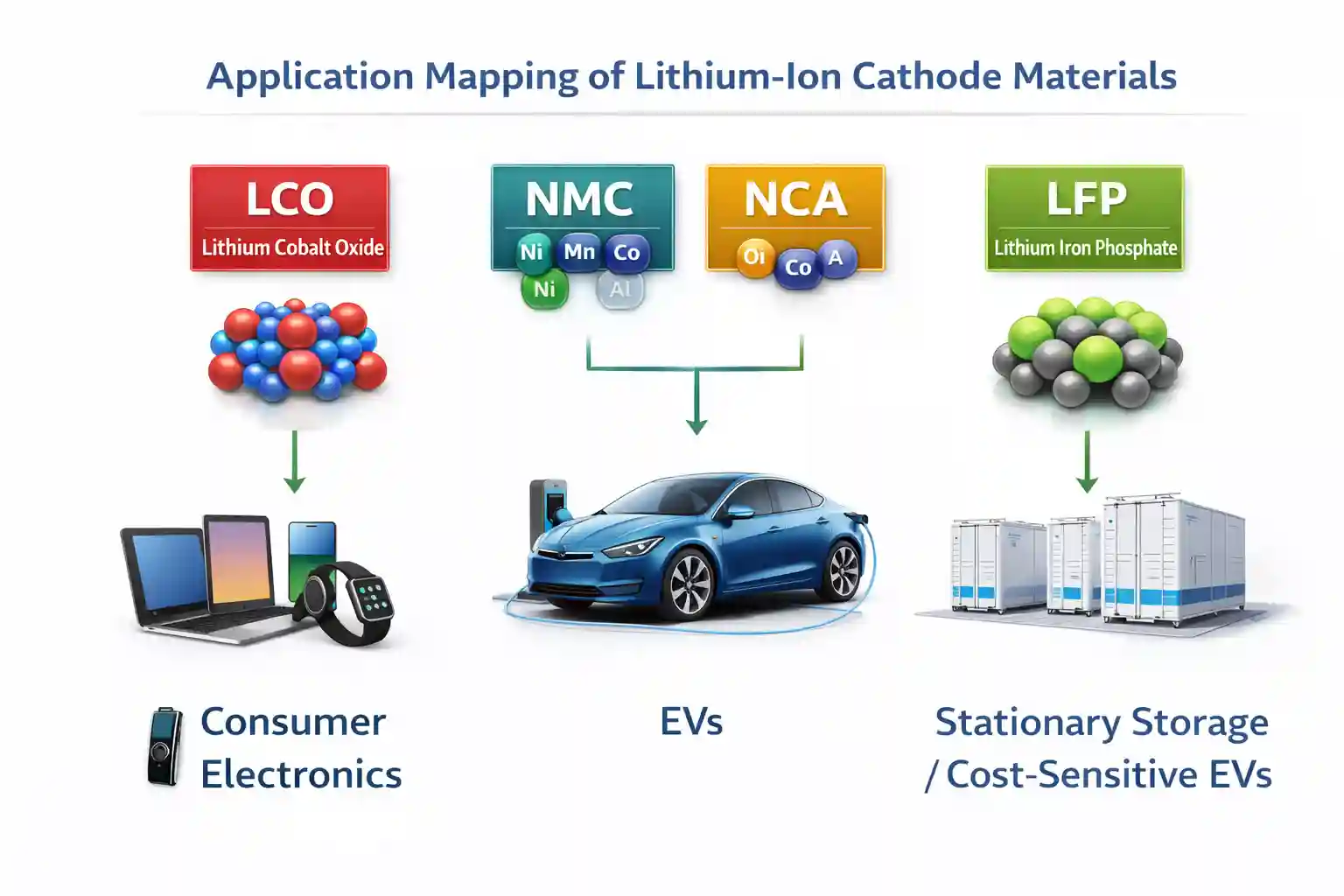
Which Cathode Materials Matter Most in Different Applications
Consumer Electronics
In consumer electronics, energy density and compact design have traditionally made LCO an important reference chemistry. This is one reason LCO still matters in classification discussions, even if its role in other battery markets is more limited.
Electric Vehicles
In electric vehicle discussions, NMC, NCA, and LFP are among the most important cathode chemistries. Each of them represents a different balance between energy density, cost, safety, and long-term battery design strategy.
Stationary Storage
In stationary storage applications, LFP has become especially important because safety, cost control, and cycle life are often more critical than maximizing energy density. This is why application context matters so much when discussing which cathode materials are “most important.”
Conclusion
Cathode classification is useful because it helps readers understand how different lithium-ion battery chemistries are matched to different design goals. In a practical overview, the most commonly discussed cathode families include LCO, LMO, LFP, NMC, and NCA, while related chemistries such as LTO should be discussed separately to avoid confusion.
There is no single cathode material that is best for every battery application. Instead, each chemistry represents a different balance of energy density, safety, cost, durability, and practical use. A clear classification structure makes these differences easier to understand and makes the article more useful for both technical readers and commercial audiences.